Monday, April 20, 2009
Tsavo Cheetah Project
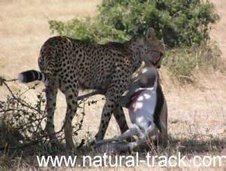
But if you come to Tsavo, she will soon show you, if you are here long enough: solid black spots glimmering in between the grass blades of the savanna, a glimpse of large copper eyes peering through a Commophora bush, or a distinctive footprint of a cat with claw marks – that of the elusive cheetah (or duma, in the Swahili language). Currently, approximately 200 cheetahs (1/4 of Kenya’s total cheetah population) are suspected to occupy the Tsavo ecosystem which covers an area of 40,000 square kilometers. But if we are to preserve this large, potentially viable population we must first obtain reliable information on numbers, distribution, conservation status and threats.
The Tsavo Cheetah Project was initiated in August 2008, after three years of preliminary work. The primary aims of this initial 4 year study are to: 1) Determine cheetah numbers and population threats in the vast and unfenced Tsavo National Parks, adjoining communities, ranches and sanctuaries. 2) Alleviate conflict issues between people and cheetahs with education and awareness. 3) Test and further develop cheetah monitoring and census techniques. Continue here..
Sunday, March 22, 2009
Camping in Kenya
The superb tropical climate with hot breezy days and cool tranquil nights gives you an interpretable sensation. The sceneries thrilled with undisturbed reserves and the great natural attractions such as lakes, Mountains ranges, snow peaks, wildlife, forests and culturated expanses will leave you dreadly inspired. An interaction with the local people in their ethnicity is a great prove that africa's diversity is unique.
Among the many places worth visit in africa, you will find Kenya tour to be more deserving. Imagine camping in the heart of wildlife thrilled savanahs surrounded by beautiful sceneries and clear open skies at night. In some places, you can opt to spend your night under open skies and enjoy the quietness of the cool breezes.
But this depends on how you plan it. The most important thing for any successful camping is advance planning. You need to plan on where to go, when, how long and the number of people you will be sharing the experience with. With these in mind, then it will be easier for you to do your budget and also know what is essential and what is not. Altenatively have a local agent do the arrangements for you.
Then its time to pack your camping gear. If you are booking your camping tour through a Kenya tour operator, then you will be exempted the task of carrying a complete gear since most Kenya tour firms will do this for you. But if this is not the case, then you will need to itemize your gear and all the essentials that you would use while camping. Depending on when and where you like to camp and what you like to do, the list will be ever changing. A tip is to think flexibility. The ease with which you can set/move camp and off course the weight of your stuff, including foods.
You've finally arrived at your camping destination and you're scoping out the area to see which spot looks best for setting up your campsite. While choosing the campsite, please consider pitching your tent on slightly high level ground to keep you safe incase of rains. You will also need to consider fundermental issues such as water source, adequate cooking area, cleaning area (don’t kill vegation with hot soapy water), garbage area and finally, consider a camping area with some shade.
After setting up the campsite it's time to go do what you came here to do, "go play!" Whatever your preoccupation is, enjoy! Do such refreshing things as; seeing the campsite set up, smelling the country air, short walks, go bird watching, take a bike ride, stroll around, eat well, enjoy a drink and if possible get a feel with the local communities. This is a refreshing change from all of the confines of the city.
Then in the evening enjoy the orange African fire while the sounds of wilderness fill the night: Night birds, the laughter of hyenas, the buzz of a mosquito or the occasional roar of lions proclaiming their territory.
Camping, whether with pals or family can be lots of fun. But you need to pay attention to a couple of things for example baboons and vervet monkeys. Baboons can be a menace and some times destructive. So as to cope with baboons and monkeys, always make sure; you close your tent, never leave you campsite unattended and constantly keep all the foodstuffs away from their, because that is what they seek. This way, you will be able to keep them off the temptation.
It's time to leave the camp? A little effort is all that you need to expend in order to ensure that the next camper arriving at the campsite after you will enjoy it just as much. The most basic principle rule for camping is: Leave No Trace. It's all about respect for nature. If campers would just leave their campsites the better than the way they found them (assuming it was clean to begin with), then we will all be doing our share in making sure that other generations will have their share of fun in the wilds of Africa.
Adventure Travel Crew
Kenya camping safaris
Natural Track Safaris
Friday, February 27, 2009
Kenya tour, shores of lake Turkana
East African Standard
The shores of Lake Turkana have offered another glimpse to early phases of human evolution.
Archaeologists have discovered a set of 1.5 million-year-old footprints at Ileret, an archaeological site at the northern shores of the lake. The footprints confirm the early man walked upright.
The discovery is reported in the current edition of Science, the journal that publishes significant original scientific research and policy issues.
The researchers from the National Museums of Kenya, Bournemouth University, George Washington University, Rutgers University and University of Cape Town say the findings add to the interpretation of the later pre-history of Africa.
According to Prof Matthew Bennet, the findings show that more than 1.5 million years ago, early man had evolved a modern human foot function and a style of bipedal locomotion that we would recognise today.
The new footprints are the second oldest in the world after the 3.7 million year-old prints in Laetoli in Tanzania. Prof Brian Richmond of George, a leading archaeologist from George Washington University, said discovery of early man’s footprints are incredibly rare event.
But for the first time, the researchers used a three dimensional method to analyse the ancient footprints and to compare them with those of modern humans.
The international team led by Prof Jack Harris of Rutgers University and Prof David Braun of University of Cape Town excavated two distinct sedimentary layers in a single outcrop at Ileret and revealed footprints that were preserved in fine-grained mud.
Footprint like human’s..
The surfaces have been dated precisely through inter-bedded volcanic ash layers to 1.51 to 1.53 million years old. Thereafter, the scientists created three-dimensional digital elevation models of the prints, which are accurate to a fraction of a millimetre.
According to Braun, the footprints were probably formed by Homo erectus, a species of hominids believed to have lived in the area during that period.
However, the major evidence is that the fossil footprints have a big toe that is in line with the other toes, a robust heel and anklebones, a pronounced longitudinal arch and short toes which are characteristics of a modern human foot.
"Through advanced scientific analysis, we were able to determine that the shapes of these prints are more like those formed by modern humans compared to the prints from Laetoli," said Bennet. Archaeologists believe the Tanzanian footprints were formed by Australopithecus afarensis, an older hominid species that lived in Eastern Africa between three to five million years ago.
But based on the size and the stride pattern of these newly discovered footprints, the team determined that the individuals responsible would have been about six feet in height.
Site at risk..
"The size and stature estimates derived from the Ileret prints compare well with those of our distant ancestor, Homo erectus, and are too large to have been formed by other hominid species that might have lived in this part of Africa," says Richmond.
According to the study, "Early Hominin Foot Morphology Based on 1.5-Million-Year-Old Footprints from Ileret, Kenya" the discovery supports archaeological hypothesis that Homo erectus had a larger home range that enhanced dietary quality and shift in cultural and biological adaptations in comparison to earlier hominids.
Unfortunately, the area in which the footprints are located is eroding, placing the valuable site at great risk. However, the process of laser scanning of the footprints is being used to preserve the discovery for posterity and further study.
"The digital scans are easily replicable and can be transformed into real-life casts available for museum display around the world or even in classrooms," says Ms Emma Mbua of the National Museums of Kenya.
The footprints are some of the recent discoveries made jointly by the National Museums of Kenya and international archaeological teams.
By Wachira Kigotho
East African Standard
Wednesday, February 18, 2009
Climbing Mount Kenya
Mount Kenya, a mountain cocktailed with numerous intrinsic worth of significance and an attractive proposal for a Kenya tour. Its native appeal have carried its lure to every generation whether past, present or those that their fate of existence is eagerly awaiting. There are superb views over the surrounding country from point Lenana. The summit is often cloacked in mist from late morning until late afternoon.
Of ultmost importance is the cultural heritage and belief of the 'Agikiyu' also known as Kikuyu who trace their roots from this magnicent dome. The Kikuyu folktale of origin is as interesting as trekking Mt. Kenya itself.
They say "During ancient creation days, a dense cloud stood over the land as Ngai (the divider of the universe) descended to earth and made his dwelling upon the snow-capped peaks of Mount Kenya. Then He (Ngai) beckoned Gikuyu to the consecrated mountain and gave him the land around Kirinyaga (Mt. Kenya) as an inheritance and treasure for Him and his descendants. Then Gikuyu went to an orchard of sacred fig trees. While resting, Gikuyu found a beautiful woman who He gave her the name Mumbi and took her for his wife. They were then hallowed with nine charmingly glance daughters who later grew into very beautiful women. The daughters kept on besseeching saying their parents saying "Oohh that we would have husbands and build our own homes so that the names of our parents would last forever"
For many moons, Gikuyu and Mumbi searched their hearts in their quest to satisfy their daugthers' desires. At last in despair, Gikuyu fell upon his knees. Raising his face to Kirinyaga he called upon his creator, to bless his daughters with husbands and Ngai heard Him and commanded Gikuyu to make a sacrifice under the orchard of the fig tree. Heeding the commandment, Gikuyu sacrificed a lamb and a sheep fowl and lit a fire with nine burning sticks and said " we have come to beseech thee for rain that satsfies our children. Say now that the rain may fall" Suddenly out of the fire came nine young men whose backs were firm and strong like the trunk of the sacred Mugumo (fig) tree and when Gikuyu saw them, he gave thanks and welcomed them to the homesated.
Unanble to resist the beauty of Gikuyu and Mumbi's daughters, they asked for their hand in marriage. Gikuyu blessed the marriages and each daughter built herself a hut and started their families thus the name of Gikuyu and Mumbi prospered. Each daugthers generation came together to form a clan thus the nine Kikuyu clans. From the tribute of Gikuyu and Mumbi and in the honor of Ngai, the Kikuyu's build their houses with doors facing Mountains Kenya. It is also not uncommon to see Kikuyu burrying their dead relatives with head facing Kirinyaga.
Tales of Kikuyu's enterpreneurship are not uncommon in the modern world, their hardwork, determination and industrious innovative investments are inspiring. This is without the fact that the Kikuyu's form the largest ethnic group in Kenya with the widest political and economical representation in Kenya. While on Kenya safari, you will not miss tales of this industrious ethnic group")
Of further startling trait is how Mount Kenya was named. Dr. Edward Krapt was the first white man to see the snow peaks on the equator and by spotting the glaciers of Mt. Kenya from a great distance he was motivated to find out more about the epidode. Curious of such an historic and fulfilling phenomena he asked a Kamba elder of the name of the mountain. Unable to pronounce Kirinyaga, the Kamba elder said Kiinyaa and Krapt translated it as Kenya thus the name upto date.
Mount Kenya is also surrounded by a national park called by the same name. The park, which was inscribed by UNESCO as a World Heritage Site in 1997 and is a Biosphere Reserve, covers 715 km2, and includes the Peaks consisting of all the ground above 3200m with two small salients extending lower down to 2450m along the Sirimon and Naro Moru tracks. Surrounding the park is approximately 2095 km2.
The park has incredible attractions such as; Pristine wilderness, lakes, tarns, glaciers and peaks of great beauty, geological variety, forest, mineral springs, rare and endangered species of animals, High altitude adapted plains game, Unique montane and alpine vegetation with 11 species of endemic plants.
The vegetation varies with altitude and rainfall, and there is a rich alpine and sub-alpine flora making the mountain beautiful and live almost to the peaks. Part of the mountain’s fascination is the variation in flora, including Giant Groundsel and Lobelia, and fauna as the altitude changes. The lower slopes are covered with dry upland forest, the true montaine (mountain) forest begins at 2,000m is mainly cedar and podo. At 2,500m begins a dense belt of bamboo forest which merges into the upperforest of smaller trees, interspersed with glades. In this area the trees are festooned with high altitude lichen.
These forest belts are host to many different animals and plants with at least 11 unique species. Game to view includes: Black and White Colobus and Sykes Monkeys, bushbuck, Rock and rock Hyrax, Greater galago, white tailed, buffalo, elephant and lower down Olive Baboon, waterbuck, Black Rhino, black fronted duikers, leopard, giant forest hog, genet cat, bush pig and hyena. More elusive is the bongo, a rare type of forest antelope. A number of other rarer species can be found here: Suni Antelope, Mt. Kenya Mole Rat, skinks (lizard), Montane Viper and a variety of owls. Occasional sightings have been recorded of albino zebra.
Birds are not abundant in the forest. But you can find Crowned hawk eagle and the Jackson's francolin. Rarely can you find the Abyssinian long-eared owl. Birds seen from the lodge include; Green ibis, African black duck, Ayres' hawk eagle, Rufous-breasted and great sparrow hawks, Scaly francolin, Silvery-cheeked hornbill, Hartlaubs turaco, red headed parrot, bronze-naped pigeon, Mackinder's eagle owl, Rupells robin chat.
There are two species of giant Lobelias; the narrow, featherly-leafed lobelia telekii and the broad-leafed lobelia keniensis which are a favorite of sunbirds for their half hidden blossoms or the thin shelled snails that make their home there. Plants also include crocus-like flower; Romuela keniensis, two terrestrial orchids - a Disa and a Habenaria, and an orange flowered gladiolus,Gladiolus Watsonioides. The high altitude heath at the top (3,000 – 3,5000m) is generally open, dotted with shrubs: African Sage, protea and helichrysum. The peak (above 3,500m) is moorland, with little game other than high altitude zebra and eland, common in the northern moorland.
Join us for trekking Mount Kenya, and enjoy this beauty on earth!
Adventure Travel Crew
African Safari desk
Natural Track Safaris
Friday, January 23, 2009
Wilds' of Africa - the remote of a Kenya tour
From the northern wondrous pyramids of Egypt to the South African Cape Town, and from the historical monuments of east African coasts of Lamu and Mombasa to the ancient docks of the slave trade triangle in West African coast. All this in simple term translate; "Africa is diverse".
Some of the most amazing characteristics of Africa are the wildlife thrilled savannahs, picturesque sceneries, Mountains, Beautiful Eastern beaches, Lovely people with incredibly diverse culture not to mention the good equatorial climate ideal for relaxing and adventures where summers and winters have no meaning.
The end of 2008 found the African safari desk crew in the interiors the country that many say 'best describes Africa' - Northern Kenya is a vast wild wilderness in its own complex. If you have been to Kenya before and you would like to set a foot back but off the beaten tracks, then northern Kenya would be an ideal place for you. The area is characterized by vast desert with temperatures rising to a height of 40 degrees Celsius and above. You will need to be ready for such high temperatures and off course be a 'tomboy' and young at heart to beat the cold nights.
Northern Kenya is home to one of the most famous but least visited national parks on a Kenya tour list. One of this Kenya's remote national parks is Marsabit. It lies about 560 km from Nairobi, and its best described as 'Kenya's most quiet and remote national park'. It has the scenic and serene Lake Paradise on top of Mt. Marsabit, elephants, Greater Kudu, mountain lions, buffalos and other wildlife. The extensive forest supports animals that would not normally be found in arid northern Kenya. There are elephants, rhinos, lions, leopards, cheetahs, buffaloes, wart hogs, Grevy's Zebra, reticulated giraffes, hyenas and antelopes to mention but a few.
Abundant rare birds are also found within Marsabit National Park. Many water birds hang out at Lake Paradise and a variety of raptors can be seen on the shaggy cliffs and in the treetops. Marsabit National Park was home to Ahmed, an elephant that I earlier told you was given 24-hour protection by a presidential order. Ahmed boasted some of the biggest tusks ever recorded and died at age 55.
Another one of this amazing parks which our crew had a chance visiting is the Sibiloi National Park. It was gazetted in 1973. Sibiloi boasts an international significance as the 'cradle of mankind'. The park teems with fossils, zebras, gazelles and impala. It is near Lake Turkana with its world famous population of crocodiles. The park covers 1570 Km2 of wilderness with scenic landscapes on the shores of Lake Turkana. Sibiloi was partially established through the initiative of the National Museums of Kenya to protect unique prehistoric and archeological sites, some of which are linked to the origin of man. The fossils include a crocodile Euthecodon brumpti, giant tortoise Petusios broadleyi, elephant Elephas recki and the petrified forest. The terrains consist of lake shore, dry semi desert bush and near desert country. The park is waterless apart from the alkaline waters of the lake.
Of the three great parks in this secluded part of Kenya is Malka Mari National Park which was gazetted in 1989 because of its high wildlife concentration. It is located along the Daua River on the Kenya-Ethiopia border in the extreme north east of Kenya on the Mandera plateau. It has a hot and dry climate. The area is largely semi arid bush land and scrubby grassland with riparian woodland and palms along the Daua River. The area is also considered a site for plant endemism. Its main attractions are; Malka Mari fort, hills and valleys. Unfortunately, it has not been developed
The areas in northern Kenya are accessible by air and road although at some points riding on camel form the other only alternative from walking giving you no other better option. The entire escapade is fun for the adventurous hearted and gives inimitable experiences far off the beaten tracks.
Adventure Travel Crew
African Safari desk
Natural Track Safaris
Sunday, November 30, 2008
Uganda - A must visit Top 10 attractions
It is almost a month now since our Nature series team launched its wide strides to
1.
The
2. Sipi falls
3. Mt
4. Tombs of
The Tombs of Buganda Kings at Kasubi are regarded as the major spiritual centre for the
5. Bwindi Impenetrable National Park
It is known for its exceptional biodiversity, with more than 160 species of trees and over 100 species of ferns. The park is part of the Bwindi Impenetrable Forest, and is situated along the Democratic Republic of Congo border next to the Virunga National Park and on the edge of the western Rift Valley. It comprises 331 square kilometres of jungle forests and contains both montane and lowland forest and is accessible only on foot. Many species of birds and butterflies can also be found there, as well as many endangered species, including the mountain gorilla. Bwindi is also an incredible preserve home to some of
6.
The Rwenzori Mountains National Park covers nearly 100,000 ha in western Uganda and comprises the main part of the Rwenzori mountain chain, which includes Africa's third highest peak (Mount Margherita: 5,109 m). The region's glaciers, waterfalls and lakes make it one of
7. Mpanga National Reserve
This is a government nature reserve 453 hectares in size. Gazette around 50 years ago, the 45km2 Mpanga forest reserve near the small town of
8.
Mabira forest lies along the main highway running from Jinja to
9.
While the communities living around the lake have many stories to tell in addition to the lake being a source of living for them,
"Lake Victoria or
10. The people of
The
Adventure Travel Crew
Natural Track Safaris
Tuesday, November 4, 2008
Gorilla tracking, a lifetime experience
In our nature series this season, our African safari desk has stretched its adventurous strides to Uganda and in the next few episodes; we are going to light our campfire around informative details, news, and facts about this wonderful East African country widely known as – the home of the rare mountain gorillas.
Uganda’s major attraction is the endangered mountain gorilla, the most profoundly built of living primates and among the most peaceable too. Staring into the pondering brown eyes of these calm giants, who share 95% of their genes with humans, is as awe-inspiring as it is exhilarating; no less so, when one realizes that fewer than 700 known individuals survive today. The groups are divided between Bwindi National Park and the Virunga Mountains south west of Congo border.
Within Uganda, there are five habituated Gorilla troops available for viewing – four in Bwindi and one in Mgahinga National Park. The groups have been given local titles which have very interesting meanings. Eight people are permitted per group per day and a total of twenty four people are taken in Bwindi, while eight people are allowed for Mgahinga.
Uganda is also home to man’s closest relative, the chimpanzee, a delightful ape whose evocative pant-hoot call is a definitive sound of the African rainforest. Chimpanzee communities have been habituated for tourism at Kibale Forest, Budongo Forest and Queen Elizabeth National Park’s Kyambura Gorge. There is also a community of orphaned chimps, most of which were confiscated from poachers, and can be visited on Ngamba Island, which lies on Lake Victoria 45 minutes by motorboat from Entebbe.
Of more exhalation is the exceptionally well representation of monkeys in Uganda. Kibale Forest boasts the greatest primate variety and density in East Africa, with five or six species likely to be observed over the course of one afternoon walk. Elsewhere, Mgahinga National Park hosts habituated troops of the rare golden monkey, while Murchison Falls is one of the few East African strongholds for the spindly, plains-dwelling Patas monkey. The fossilized 20-million-year-old bones of Morotopithecus, the earliest-known ancestor of modern apes and humans, were unearthed in the 1960s near Moroto in Eastern Uganda, and are now housed in the National Museum in Kampala.
Tracking Gorillas is one of immensely fascinating and sometimes very emotional experience for many taking safaris in Africa, whilst for others it often fulfils a lifetime ambition. The most famous areas for gorilla tracking are in the Bwindi Impenetrable forest. The best way for a perfect tracking is guided nature walks between Buhoma in the Bwindi Impenetrable Forest and the town of Kisoro via Nkuringo and vice versa.
This experience offers a low cost insiders perspective into village life in rural Uganda highlighting some of the wonders of Bwindi Impenetrable Forest all at your own pace. Gorilla tracking is a very captivating activity; it involves walking in the wilderness in search of these great apes. It can be a challenging activity, therefore ensure physical fitness.
It is paramount to know that the Uganda wildlife authority requires you to have a tracking permit; Booking for all gorilla permits in Bwindi and Mgahinga is done at UWA Headquarters in Kampala. Advance permits are available as early as two years.
Another great encounter is the Chimpanzee tracking. The way they feed, climb trees, respond to humans and the care they show for their young ones, is just phenomenal. Kibale national park, Queen Elizabeth and Murchison falls national park are a haven of Chimpz. I know the fact that Chimpz are 'cousins to humans' is not a new tale to you. For the more adventurers, you can be part of the habituation team that goes in the morning to study the behavior of this primate in order to make them get used to human beings.
Adventure Travel Crew
African safari Desk
Natural Track Safaris