Showing posts with label Safaris in kenya. Show all posts

Saturday, April 2, 2011

Gorilla experience in Rwanda

It is now official that the number of one of the world’s most charismatic and endangered species is out and its good news to the world today especially the enthusiastic conservationists. This is according to the partial report posted by the African Wildlife Foundation in Kigali, Rwanda.

The analysis of the census conducted in last year indicates that there were a total of 480 mountain gorillas, (Gorilla beringei beringei), in 36 groups along with 14 solitary silverback males in the Virunga Massif.

Along with the 302 mountain gorillas censured in Bwindi in 2006 and four orphaned mountain gorillas in a sanctuary in DRC, this brings the new total world population to 786 individuals. The last census undertaken in the Virunga Massif was in 2003, when the population was estimated at 380 individuals.

The current figure represents a 26.3 % increase in the population of mountain gorillas in this area over the last seven years, which is a 3.7 % annual growth rate. This increase in the population occurred despite the killing of no less than nine mountain gorillas, in four separate incidents, during this time period.

Of the 480 mountain gorillas censured, 352 (73%) were habituated (349 in groups and three solitary males) and 128 were unhabituated (117 in groups and 11 solitary males).

Virunga massif includes three contiguous national parks namely; Parc National des Virunga in DRC, Volcanoes National Park in Rwanda and Mgahinga Gorilla National Park in Uganda. The only other location where mountain gorillas exist is Bwindi Impenetrable National Park in Uganda.

The goal of the census was not only to assess the population level of the mountain gorillas, but their level of health as well. Analyses conducted on fecal samples will contribute to one of the most comprehensive health screenings of any wild ape population.

The results will also be extremely valuable in order to make comparisons between populations, and between habituated and unhabituated groups. These results will not only serve as a baseline for understanding the health status of the mountain gorillas, but may also provide insights into past and future exposure to human pathogens.

The census itself was an exercise in collaboration, and IGCP played a lead role in attracting support for the census and coordinating all participating institutions and organizations. Over 1,000 kilometers were systematically walked by six mixed teams of seventy-two people from DRC, Rwanda, and Uganda.

Teams covered the entire range and meticulously documented fresh signs of mountain gorilla groups. Genetic analysis of fecal samples collected was analyzed to identify and correct for any double-counting of individuals or groups, ensuring the most accurate estimate for the population.

Although habituated mountain gorillas are continuously monitored, periodic census of the population is a necessary step in conservation. The census not only recorded the presence of mountain gorillas, but also the presence of other large mammals and illegal activities like bamboo cutting and snares.

While the incredible increase in this population of mountain gorillas is clearly a good thing and cause for celebration, the threats to their existence are persistent. Recently, a coordinated patrol discovered and destroyed just over 200 snares in the Virunga Massif over a five-day patrol. Although poachers typically do not target mountain gorillas, the snares they set are a threat nonetheless.

The Virunga Massif mountain gorilla census was conducted by the protected area authorities in the three countries: L’Institut Congolais pour la Conservation de la Nature, the Rwanda Development Board and the Uganda Wildlife Authority.

The census was supported by the International Gorilla Conservation Programme (a coalition of the African Wildlife Foundation, World Wide Fund for Nature, and Fauna & Flora International), the Max Planck Institute for Evolutionary Anthropology, the Dian Fossey Gorilla Fund – International and the Mountain Gorilla Veterinary Project.

The census was funded by WWF-Sweden, Fair Play Foundation, and the Netherlands Directorate General for International Cooperation (DGIS) through the Greater Virunga Transboundary Collaboration.

The full report of the census, which will be available in 2011, will include details on population dynamics and distribution of the Virunga gorilla population as well as population structure and genetic composition. These details will provide a scientific basis from which IGCP and other conservation institutions and organizations will plan collective conservation efforts.


PKP-Kenya safari desk

Natural Track Safaris

Thursday, January 6, 2011

The Zanzibar Island, experience unchanged history

Although there’s more to the islands of Tanzania than just Zanzibar, Zanzibar enchants and fascinates with its oriental mystique and forgotten exoticism -- the very name evokes the Spice Islands and the dhow trade, sultans and palaces built of limestone and coral against the palm trees and the crashing surf.

Zanzibar’s coastline offers some of the best beaches in the world, but sand and surf vary depending on what side of the island you’re on. On the east coast, waves break over coral reefs and sand bars offshore, and low tide reveals small pools of starfish, small minnows, and anemones. Up north, ocean swimming is much less susceptible to the tides, and smooth beaches and white sand make for dazzling days in the sun.

Portuguese invasion and control of the Swahili Coast in the late 16th century ended the golden age of the archipelago, although the Omani Arabs returned to power less than a century later. The port city of Stone Town dominates the west coast, and although the beaches of Mangapwani, where slave caves are visible at low tide and nearby Bububu are less than half an hour’s drive away, a night or two spent on the east or north cost is well worth the extra hour it takes to drive there. That said, the Chole Island Marine Park just off Stone Town – and nearby Prison, Grave, and Snake Islands – make a refreshing day-trip and a good break from exploring the winding passageways of the old city.

On the south coast of Zanzibar lies the Menai Bay Conservation Area, a sea turtle protection area for the endangered species that come to breed on the island. Roads to the southeast coast take visitors through the Jozani Forest, home to Zanzibar’s rare Red Colobus monkeys and a number of other primate and small antelope species.

Today, many of the winding streets and high town houses of old Stone Town remain unchanged and you can walk between the sultan’s palace, the House of Wonders, the Portuguese fort and gardens, the merchants’ houses, and the Turkish baths of the old city. Day-long spice tours to working plantations offer visitors the chance to observe the cultivation of cloves, vanilla, nutmeg, cinnamon, and other spices that have made the island famous.

PKP- Kenya safari desk

Natural Track Safaris


The Bat-eared Fox

The Bat-eared Fox (Otocyon megalotis)with the name Otocyon which is derived from the Greek words "oto" for ear and "cyon" for dog is a canid of the African savanna, named for its large ears. The ears of bat-eared foxes can grow up to 5.3 inches long and have an average weight of about 2.2-4.5 kg.

The teeth of the Bat-eared Fox are much smaller than teeth of other canid species. This is an adaptation to its insectivorous diet, insects making up as much as 80% of its food intake.Bat-eared foxes use these specialized ears to locate termites, dung beetles, rodents, birds ,eggs and sometimes fruits and other insects, which make up most of their diet. Bat-eared foxes can hear larvae chewing their way out of an underground dung beetle ball. They can also detect the sound of harvesting termites chewing on short grasses. Surviving on an all-insect diet required several adaptations in the bat-eared fox. In addition to their large and powerful ears, bat-eared foxes have specialized extra teeth for chewing up insects, and their lower jawbone is designed to open and close rapidly.

The body of the bat-eared fox is ashy gray in color with black limbs and tail. The backs of its enormous ears are also black, and it has a raccoon-like white facemask. The underside of its neck and belly are paler than the rest of its body.

Bat-eared Foxes are mostly nocturnal animals that live in small groups consisting of mated pairs and their young. The pairs live in dens and typically raise two to five pups together. Mated pairs are very social and are monogamous, Bat-eared foxes mate for life, and sometimes two females will mate with one male and share a communal den. The father is very invested in the rearing of young, and he spends a great deal of time baby-sitting. While the father is watching the cubs, the mother is free to forage for food, including insects, which are a steady food source. Though they are low in nutrition and cannot be regurgitated for the young, they allow the mother to take in the necessary amount of food needed to produce milk for the cubs.

Bat-eared foxes are hunted by several different mammal species, including cheetahs, jackals, spotted hyenas, rock pythons, African wild dogs, and leopards. Their large, bushy tails work as a rudder when fleeing from predators in a zig-zag pattern. They are fast and good at dodging, but their best chance at escaping predation is by fleeing to their underground dens, which have several entrances and multiple chambers connected by tunnels. A bat-eared fox family may have several dens throughout their home range.

Bat-eared foxes are also preyed upon by raptors and must keep a watchful eye while foraging. Most of their foraging is done alone at night. While looking for food, these foxes walk slowly and quietly with their noses to the ground and their ears cocked forward, listening for insects.

Look for them when outdoor, usually in the morning hours, they can be seen warming up in the morning sun, before getting into their dens when it gets hot.

PKP-Kenya safari desk

Natural Track Safaris

Thursday, December 30, 2010

Hyena that hunts birds

The spotted Hyena (crocuta crocuta) of Africa has been known to be a greedy scavenger who largely feeds on left-overs from kills of other predators, mostly depicted as cowards and poor hunters.

You must have heard of this common myth which says that ‘if you are taller than the hyena it will not attack you but if you are shorter it will attack you’, which many of us have believed without even seeing a Hyena itself.

The real truth is that, these strong jawed creatures have crudely proved in many occasions to be aggressive and intelligent hunters. The spotted hyenas of Lake Nakuru have proved this point beyond any shadow of doubt, they hunt flamingos.

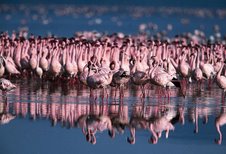
A kenya safari to Lake Nakuru will take one to the Commorant lakeshore for a stopover that presents a panoramic splendor of water fowls, the flamingos, pelicans, gulls and a host of other birds. One is most likely to spot the hyenas outside their den basking in the sun or wallowing in muddy pools with their young ones.

Adult hyenas hunt solitarily, mostly between dusk to dawn. When approaching flamingos the hyena lowers its head to a reasonable distance, dashes and grips the flamingo as they scamper for safety. It has become apparent that this new delicacy is increasingly being preferred by hyenas in Lake Nakuru. In most places, hyenas, like other carnivores adapt to feeding what is available to them in that particular reserve/park.

The state at which the lure for this strange action has been observed is just unique. In the past few years you would rarely spot hyena's along the shores, especially the Cormorant shores, but today, you can easily find them in big numbers lying sluggishly on the beach as they await for any opportunity to pounce.

Seeing is believing or so they say, a visit is inevitable for who knows how long this spectacle will last before the hyenas switch to a different delicacy that will send them deep into the forest and make them hard to see.

PKP-Kenya safari desk

Natural Track Safaris

Tale of African Snakes - affirm the traditional dilemmas

Many people are scared of snakes and to many, a snake is a snake, all are dangerous and deserve death. However, most snake species are completely harmless! In fact, about 80% of all snakes’ species in the world are non-venomous and perform important ecological functions as controllers of rodent- pest populations. Thus knowing how to identify snakes is a vital part of our lives and conservation education

The wilds of Africa are often associated with snakes and rightly so, but, unfortunately, usually for the wrong reasons. Africa is well known amongst herpetologists and snake lovers for the interesting variety of species of which some are unfortunately highly priced in the pet trade.

Although many of the African snakes’ species are completely harmless to humans, this region also hold some of the worlds most deadly snakes. The Black and Green Mamba, Puff Adder, Cobra, Boomsland, and Saw-scaled Vipers are some of the worlds most deadly snakes and deserve a great deal of respect.

In east Africa, there are close to 200 species of snakes. Of these 200, 47 are considered dangerous to humans, 45 are venomous and two are large constrictors (two species of pythons very similar in appearance). Of the 47 dangerous species mentioned, 18 species are known to have killed people.

Kenya is home to several of the most dangerous species for example, the Puff Adder (Bitis arietans), Black-necked Spitting cobra (Naja nigricollis) and Black Mamba (Dendroaspis polylepis). However, Kenya is also home to many harmless species that feed on rats and mice that consume maize, millet and rice, the stable diet of the people of Kenya.

The simplest way of describing snakes is whether a snake is Harmless, Mildly Venomous or Dangerous. Some snakes have no venom and are completely harmless like the Brown House Snake. Others like large pythons may be non-venomous but are still considered dangerous.

Sand snakes (genus Psammphis) are considered mildly venomous. This means that the venom is strong enough to subdue or kill its prey, like a small lizard, but not strong enough to kill an adult human. However, one should still be careful around these fast moving serpents. Young children or adults that have allergic reactions could suffer severe symptoms from the bite of a sand snake!

In general, African is home to an abundance of different snake species. From its deserts to savannahs, the African landscape is home to an enormous variety of extremely beautiful and potentially dangerous snakes. Below are some of the most popular snake classification;

Colubridae / Colubrids – A Colubrid is a snake that is a member of the Colubridae family. It is a broad classification of snakes that includes well over half of all snake species on earth. While most colubrids are non-venomous (or have venom that isn't known to be harmful to humans) and are normally harmless, a few groups, such as genus Boiga, Coluber and Rhabdophis, can produce medically significant bites. In addition, the Boomslang and African Twig Snake have both caused human fatalities.The venom-injecting fangs associated with venomous colubrids are almost always in the back of the mouth, compared to vipers and elapids. In North America, all snake species in the colubridae family are generally harmless to humans. Please note: This list does not currently include sub-species.

Elapidae/ Elapids (Venomous) – The cobra family is thought to have evolved from Colubrid snakes and many appear very similar in appearance with long, slender bodies and large scales (plates) on the head. They differ in having more advanced venom delivery systems than the venomous Colubrids. Elapids have fangs that are "effectively tubular" in that the fangs contain grooves that are enclosed by an infolding of the edges. The fangs are in the front of the mouth rather than the rear as is seen in venomous Colubrids. The Elapidae contains some of the world's most dangerous snakes including cobras (Naja), mambas (Dendroaspis) and sea snakes (Hydophinae and Laticaudinae). Elapids are found worldwide and in Ausralia is the predominant family. In North America, three species of elapids are found, two species of coral snakes and one sea snake. The coral snakes are relatively small snakes that spend most of their time underground. Their primary food is other snakes. Despite their small size and small fangs, their venom is extremely toxic.

Viperidae / Vipers (Venomous) – The vipers are generally considered to be the most advanced family of snakes since they possess a very sophisticated venom delivery system. Large tubular fangs are placed in the front of the mouth and they are hinged, allowing them to be folded back when not in use. Their heads are covered with numerous small scales and their eyes have vertically eliptical pupils.

What to do when you meet a snake?

First of all, except for the slow-snakes like puff adders, you will generally see a snake swiftly pass by you, not even enough time to take a photo. That being a general rule, always leave snakes alone, don’t touch them unless you are a professional snake handler. Like all wildlife, they deserve their respect and distance from our interference. Except for cases where human-pet life is in danger, leave them alone, unless it is absolutely necessary to have them moved.

PKP- Kenya safari desk

Natural Track Safaris

The newest wildlife sanctuary in Kenya

As you drive on the Nakuru-Nairobi highway the sight of Lake Elementeita will certainly catch your attention especially with its pink coloured islands and shorelines. You may as well spot gazelles and zebras grazing on the open plains. This is Lake Elementeita, a soda that is the newest wildlife sanctuary in Kenya today.

Lake Elementeita is the only breeding ground for the great white Pelican in Kenya and neighbouring countries. These fish-eating birds nest on rocky islands in the lake. In addition, the lake attracts visiting flamingos, both the Greater and Lesser varieties, which feed on the lake's crustaceans and insect larvae and on its suspended blue-green algae, respectively.

The lake surroundings have a rich history. Nearby is the Kariandusi Museum, which is an important prehistoric site where stone hand-axes and cleavers were discovered in 1928 by Louis Leakey. Elementeita Badlands is a lava flow to the south of the lake covered in bush and including some spectacular scenic peaks in the nearby Utut area

The survival of Lake Elementeita and its environs have been threatened by incompatible land use practices. KWS has been working with the stakeholders around Lake Elementeita and its catchment area to come up with mitigation measures. This led to the formation of an organization called Greater Lake Elementeita Conservation Area (GLECA) to push for the enhancement of conservation status of the area. After a series of consultation with stakeholders including the local communities, it was finally agreed that Lake Elementeita be accorded the status of protected area.

The Minister for Wildlife and Forestry Hon. Dr. Noah Wekesa formally gazetted it on 6th July 2010 as a Wildlife Sanctuary. The sanctuary is approximately 2533.9 hectares.

Following the gazettement, KWS and GLECA are now working towards completion of the sanctuary’s Management Plan which will chart out issues to do with environmental conservation, tourism, and community enterprise and business development among others. KWS and GLECA are in the process of demarcating the boundaries, developing infrastructure and stationing personnel in the area to ensure illegal activities that are detrimental to the ecological integrity are checked.

With this new development it is expected that tourism activities will be improved and diversified for the benefit of the local community while at the same time securing space for wildlife.

Lake Elementeita together with Lakes Nakuru and Bogoria has also been nominated for enlistment as World Heritage Site. We look forward to that. Have a nice visit in these Rift Valley lakes.

PKP-Kenia Safari desk

Natural Track Safaris

Friday, October 22, 2010

Birds Migration

Bird migration is one of the great mysteries of nature. The earliest recorded observations of bird migration were 3000 years ago, as noted by Hesiod, Homer, Herodotus, Aristotle and others. The Bible also notes migrations, as in the Book of Job (39:26), where the inquiry is made: "Doth the hawk fly by Thy wisdom and stretch her wings toward the south?" The author of Jeremiah (8:7) wrote: "The stork in the heavens knoweth her appointed time; and the turtledove, and the crane, and the swallow, observe the time of their coming."

Each year, millions of birds leave the comfort of Africa and fly across deserts, mountains and oceans. They fly north to Europe and Asia, where they build their nests and raise their young. A few months later they undertake another great journal to return to Africa.

They fly north when it is spring and summer. There at that time, the sun is over northern hemisphere. Spring and summer days in northern countries are much longer than the nights. The sun may rise at 4am and set at 9pm north of the Arctic Circle. The sun does not set at all in mid June. This gives the birds plenty of time to look for insects to feed their young.

Sometimes circumstances such as a good breeding season followed by a food source failure the following year lead to interruptions in which large numbers of a species move far beyond the normal range.

The primary advantage of migration is conservation of energy. The longer days of the northern summer provide greater opportunities for breeding birds to feed their young. The extended daylight hours allow diurnal birds to produce larger clutches than those of related non-migratory species that remain in the tropics year round. As the days shorten in autumn, the birds return to warmer regions where the available food supply varies little with the season.

During the cold, dark months of the northern winter, few insects survive. With the coming of warm, sunny days, insects hatch in large numbers. The resident birds cannot manage to eat them all. This leaves plenty of insects for food for migratory birds to eat and feed their young.

In fresh water wetlands and seashores, tiny crustaceans also multiply in the summer, and eventually there is abundant food for wetland birds.

Some large birds such as White Stocks may follow landmarks along their route while some small birds such as Nightingales migrate at night and may be guided by the stars. Scientists continue to study migrating birds hoping to understand how they make that amazing journey.

Migrating does not only happen to Africa. Birds also migrate from southern Asia and Australia to northern Asia; and from South and Central America for instance; The Arctic Tern, a beautiful silvery seabird migrates from Arctic Circle in the north all the way to the Antarctic in the south. A few birds migrate in other directions: from the tropics to lands far in the south and back again.

In Kenya, more than 100 species of birds migrate to Kenya from other continents. Some of these stay in Kenya until they fly north again. Others continue their migration to southern Africa while a few migrate to Kenya from Madagascar and southern Africa.

Migratory birds in Kenya safari include White Stocks, Plovers and Sandpipers, Barn Swallows and Nightingales among many others. Usually Migrating birds follow directions called flyways. In Kenya, flyways pass through the coastal and eastern lowlands, the central highlands, the rift valley and Lake Victoria.

You don’t need to be a birder to enjoy seeing migrating flocks. All you need is a spirit of adventure, and enjoy being outdoors.

PKP-Kenya safari desk

Natural Track Safaris

Saturday, October 9, 2010

The Wild Dog

The scientific name "Lycaon pictus" which is derived from the Greek for "wolf" and the Latin for "painted".The African Wild Dog is a medium sized canid found only in Africa.

It is the only species in the genus Lycaon.

It is also called the Painted Hunting Dog, African Hunting Dog, the Cape Hunting Dog, the Spotted Dog, or the Painted Wolf in English, and Mbwa mwitu in Swahili. Adults typically weigh 17-36 kilograms (37-79 pounds). It stands about 30 inches (75 cm) at the shoulder, with a head and body length averaging about 40 inches (100 cm) and a tail of 12 to 18 inches (30–45 cm).

There is little sexual dimorphism, though judging by skeletal dimensions, males are usually 3-7% larger.it has 42 teeth in total. The premolars are relatively large compared with those of other canids, allowing it to consume a large quantity of bone, much like hyenas.The heel of the lower carnassial M1 is crested with a single cusp, which enhances the shearing capacity of teeth and thus the speed at which prey can be consumed.

This feature is called trenchant heel and is shared with two other canids: the Asian Dhole and the South American Bush Dog. The African Wild Dog reproduces at any time of year, although mating peaks between March and June during the second half of the rainy season. Litters can contain 2-19 pups, though 10 is the most usual number.

The time between births is usually 12–14 months. Pups are usually born in an abandoned den dug by other animals such as those of the Aardvark. Weaning takes place at about 10 weeks. After 3 months, the den is abandoned and the pups begin to run with the pack. At the age of 8–11 months they can kill small prey, but they are not proficient until about 12–14 months, at which time they can fend for themselves.

Pups reach sexual maturity at the age of 12–18 months. In packs, there are separate male and female hierarchies that will split up if either of the alphas die. In the female group, the oldest will have alpha status over the others, so a mother will retain her alpha status over her daughters. For the males, in contrast the youngest male or the father of the other males will be dominant.

Dominance is established without blood-shed, as most dogs within a group tend to be related to one another in some way, and even when not this can occur. They have a submission-based hierarchy, instead of a dominance based one. Unrelated African Wild Dogs sometimes join up in packs, but this is usually temporary. Occasionally, instead unrelated cape dogs will attempt hostile takeovers of packs.

The African Wild Dog hunts in packs. Like most members of the dog family, it is a cursorial hunter, meaning that it pursues its prey in a long, open chase. The dogs have a peculiar rather playful ceremony that bonds them for a common purpose and initiates each hunt. They start circulating among the other pack members, vocalizing and touching until they get excited and are ready to hunt.

Its voice is characterized by an unusual chirping or squeaking sound, similar to a bird. After a successful hunt, hunters regurgitate meat for those that remained at the den during the hunt, such as the dominant female and the pups. They will also feed other pack members, such as the sick, injured, the very old that cannot keep up, or those who stayed back to watch the pups.

The African Wild Dog's main prey varies among populations but always centers around medium-sized ungulates, such as the impala, Thomson's Gazelle, and wildebeest. While the vast majority of its diet is made up of mammal prey, it sometimes hunts large birds, especially Ostriches. Hunting larger prey requires a closely coordinated attack, beginning with a rapid charge to stampede the herd.

One African Wild Dog then grabs the victim's tail, while another attacks the upper lip, and the remainder disembowel the animal while it is immobilised. This behaviour is also used on other large dangerous prey, such as the African Buffalo, giraffe calves, and large antelope even the one-ton Giant Eland.

The dogs often eat their prey while it is still alive. Remarkably, this large-animal hunting tactic appears to be a learned behavior, passed on from generation to generation withinthe species. The home range of packs varies enormously, depending on the size of the pack and the nature of the terrain.

Their preferred habitat is deciduous forests because of large prey herd size, lack of competition from other carnivores, and better sites for denning. No two wild dogs are marked exactly the same, making it easy to identify different individuals. Why such a pattern should develop, and how it serves the hunting dog, has long intrigued scientists.

These long-legged canines have only four toes per foot, unlike other dogs, which have five toes on their forefeet. African hunting dogs are endangered. They are faced with shrinking room to roam in their African home. They are also quite susceptible to diseases spread by domestic animals.

PKP-Kenya safari desk

Natural Track Safaris