Malindi’s ancient history, authentic cultural and epic architectural, location puts it in a limelight of sundry interests. However, it is the diversity of holiday making choices that gives Malindi its definitive identity – the tropical paradise’. Following the sign posts, drive through the beautifully hedged, villas, resorts and mansion tangled finely amidst indigenous flora and the last left turn takes you straight to Malindi Marine Park.
Enveloped by a national reserve and a 100ft strip of coastal land starting from Vasco-da-Gama pillar, Malindi Marine Park is located 4km south of Malindi town extending to Mida creek, neighboring Gede ruins and Arabuko sokoke forest, then down to Watamu. It was the first marine protected area in Kenya established in 1968 and designated as a Biosphere reserve under the Man and Biosphere Reserve program of UNESCO in 1979.
It is one of those places to add on to your Kenyan safari itinerary.
Malindi Marine Park is endowed with a variety of unique resources such as fringing reefs, coral gardens in the lagoons, sea grass beds, mangroves, mudflats and a high diversity of fish and marine mammals including turtles and shorebirds. Among the species of fish found in the park include coral reef fish, sweetlips, surgeon fish, butterfly fish, damsel and parrotfish.
The untold phenomena of tidal islands that appear magically during the low tides are such an incredible scenario. Imagine walking almost a kilometer in the sea on soft white sand overlooking crystal blue fast flowing waters in the adjacent fringing reef. Then with a glass bottom boat, cross the reef and you are rewarded with a seemingly endless lagoon intercepted by white magical islands. And the experience repeats itself over and over as you sail inner to the coral garden and far stretch to Mayungu … and that is just a glimpse of Malindi Marine Park!
Whether you are snorkeling or scuba diving, you are sure to marvel at the under water beauty, or may just bump into other regular visitors to the Malindi marine park – this may include turtles feeding on the thallasia beds and dolphins feeding on shimmering schools of sardine. On the leeward side of north reef, there has a low coral cover with large schools of Barracuda and occasional reef sharks that are commonly encountered, as well as large rays that feed on the bottom.
Swimming in the warm ocean water, snorkeling, boat rides, diving, and dhow rides, sun bathing and educational tours are among the diverse activities at Malindi Marine Park. All this is without mentioning implausible picnics and barbeque on island, wind surfing (in the reserve), and occasional beach clean up and research.
There is no charge to use the beach for swimming, sunbathing or exploring the many tidal pools. However, a park fee is charged for visitors using boats to go snorkeling, scuba diving or observing the coral reefs.
It is no doubt that Kenya has earned a notch in the world as a preferred destination for those seeking ultimate jungle experience, adventures in the wilderness and precise comfort in a wildlife thrilled parks and reserves. "kenya safari ” was launched this year by the government of Kenya through ministry of tourism as the Kenya’s official destination brand.
Your favorite, reliable and authoritative safari blog ‘African adventure crew’ headed by Francis was again on the ground to see whether this was reflected in truth or it was just a fiction. From our extensive experiences from the holiday makers, we have in this season’s ‘Nature series’ heard stories on real time adventure and eye witness experiences from varied holiday makers in Kenya over the peak months of July and August.
Bob and Kristina - UK
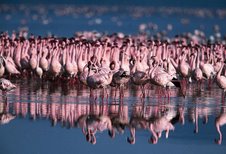
We first met Bob and Kristina an elderly couple that had come to Kenya to mark their lovely 40th anniversary in marriage. The couple had left Samburu national reserve the day before, and had just completed an early morning game drive in L. Nakuru national park. All cheerful and elated with Joy, it was easy to overture and bond with them thanks to the great awe inspiring experiences that kept them smiling all through. To Kristina, seeing Kudus in the wild amidst unique wildlife of samburu was a sought-after memory. In Lake Nakuru, they were lucky to spot the endangered black rhino, while the white rhinos and the stunning panoramic of millions of flamingos roamed were just infront of them. Their itinerary was skillfully and precisely drawn to ensure they touched every heart of the best and unique wilds during their Kenya safari.
Seane story - Australia
The next day we met Sean and party from Australia. No doubt, this young couple must have had a hint of the best way to explore Kenya’s wildlife – camping safari! Their choice to do their Kenya camping safari in August was sheer brilliance as the weather is generally favorable. After breakfast, we proceed to hells gate national park. Sammy the cook had made a yummy packed lunch for the group. Hiking the hells gate was not just a lovely experience but also a great adventure and exercise.
Our choice to set our survey base around the two rift valley lakes – Nakuru and Naivasha was a pre-arranged due to the central location and popularity. Lake Nakuru is Kenya’s premium national park offering a diverse ecosystem and great wildlife spotting within a close range. Lake Naivasha on the other hand hosts the most deluxe vacation resorts and campsites with diverse wildlife and great boating excursions. It is at these two lakes where you can meet tourists with unique and varied itineraries and therefore a chance to obtain views from mixed experiences and different destinations.
Martin Black’s family
We met Martin Black, his mama 79 and three children on the forth day of our program. By then, the group had seen more than they had expected. The two girls were drawing pictures of various wildlife that they had seen, while the young boy was busy playing games and listening to music. Even though this particular group had lived in many places of the world, they openly confessed that Kenya is a ‘paradise’ thanks to scores of wildlife, beautiful sceneries and white-sanded coastal beaches not forggeting the friendly and charming people.
Melywn family - UK
On the fifth day of our analysis, I met the lovely and exciting vacationers of the season – the Melywn’s family from UK. Their driver/guide, Charles made an incredible introduction causing a quick confidence and bond between the two parties. Immediately after briefing, we engaged in a conversation unconscious that we were running behind time. On the way to Naivasha we had great talks as the group shared their experiences and also asked questions on various issues concerning Kenya. The group did a trek in Hells gate national park as well as taking photos of the magnificent Hells gate Gorge, Fischer,s and Central towers and the splendid view of Lake Naivasha from Olkaria hill. The group saw myriad wildlife and inimitable sceneries through out their safari.
Yifat family - Israel
Shalom!! thats how it started. Our last group in this series was Yifat family from Israel. Having visited ‘north of equator’ wildlife parks, they had a great comparison with the lower equator parks. It is amazing how nature is discrete with unsearchable uniqueness. Unlike other African destinations, Kenya wildlife observe the hemispherical rules in that some species are only found on the northern part of equator while others are purely restricted to the southern. Yifat family then proceded to hike the Menengai crater. The crater lies at 2272 meters above sea level and was formed as result of combined rift valley and volcanic activities. The ashy smell from molten lava can be felt up to date while the whole floor is covered by black volcanic rocks and shrubs. On clear days, one can see most rift valley lakes such as Bogoria, Baringo, Elmentaita and the near by Lake Nakuru.
The Tsavo National Parks, in south eastern Kenya, are probably most renowned for the notorious, mane-less, man-eating lions of the late nineteenth century… or even the numerous ‘red elephants’ covered in red dust from the sands which blanket the grounds of the vast, bio-diversity rich Tsavo ecosystem.
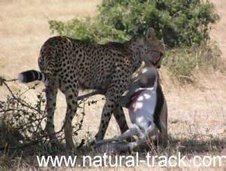
But if you come to Tsavo, she will soon show you, if you are here long enough: solid black spots glimmering in between the grass blades of the savanna, a glimpse of large copper eyes peering through a Commophora bush, or a distinctive footprint of a cat with claw marks – that of the elusive cheetah (or duma, in the Swahili language). Currently, approximately 200 cheetahs (1/4 of Kenya’s total cheetah population) are suspected to occupy the Tsavo ecosystem which covers an area of 40,000 square kilometers. But if we are to preserve this large, potentially viable population we must first obtain reliable information on numbers, distribution, conservation status and threats.
The Tsavo Cheetah Project was initiated in August 2008, after three years of preliminary work. The primary aims of this initial 4 year study are to: 1) Determine cheetah numbers and population threats in the vast and unfenced Tsavo National Parks, adjoining communities, ranches and sanctuaries. 2) Alleviate conflict issues between people and cheetahs with education and awareness. 3) Test and further develop cheetah monitoring and census techniques. Continue here..
The shores of Lake Turkana have offered another glimpse to early phases of human evolution.
Archaeologists have discovered a set of 1.5 million-year-old footprints at Ileret, an archaeological site at the northern shores of the lake. The footprints confirm the early man walked upright.
The discovery is reported in the current edition of Science, the journal that publishes significant original scientific research and policy issues.
The researchers from the National Museums of Kenya, Bournemouth University, George Washington University, Rutgers University and University of Cape Town say the findings add to the interpretation of the later pre-history of Africa.
According to Prof Matthew Bennet, the findings show that more than 1.5 million years ago, early man had evolved a modern human foot function and a style of bipedal locomotion that we would recognise today.
The new footprints are the second oldest in the world after the 3.7 million year-old prints in Laetoli in Tanzania. Prof Brian Richmond of George, a leading archaeologist from George Washington University, said discovery of early man’s footprints are incredibly rare event.
But for the first time, the researchers used a three dimensional method to analyse the ancient footprints and to compare them with those of modern humans.
The international team led by Prof Jack Harris of Rutgers University and Prof David Braun of University of Cape Town excavated two distinct sedimentary layers in a single outcrop at Ileret and revealed footprints that were preserved in fine-grained mud.
Footprint like human’s..
The surfaces have been dated precisely through inter-bedded volcanic ash layers to 1.51 to 1.53 million years old. Thereafter, the scientists created three-dimensional digital elevation models of the prints, which are accurate to a fraction of a millimetre.
According to Braun, the footprints were probably formed by Homo erectus, a species of hominids believed to have lived in the area during that period.
However, the major evidence is that the fossil footprints have a big toe that is in line with the other toes, a robust heel and anklebones, a pronounced longitudinal arch and short toes which are characteristics of a modern human foot.
"Through advanced scientific analysis, we were able to determine that the shapes of these prints are more like those formed by modern humans compared to the prints from Laetoli," said Bennet. Archaeologists believe the Tanzanian footprints were formed by Australopithecus afarensis, an older hominid species that lived in Eastern Africa between three to five million years ago.
But based on the size and the stride pattern of these newly discovered footprints, the team determined that the individuals responsible would have been about six feet in height.
Site at risk..
"The size and stature estimates derived from the Ileret prints compare well with those of our distant ancestor, Homo erectus, and are too large to have been formed by other hominid species that might have lived in this part of Africa," says Richmond.
According to the study, "Early Hominin Foot Morphology Based on 1.5-Million-Year-Old Footprints from Ileret, Kenya" the discovery supports archaeological hypothesis that Homo erectus had a larger home range that enhanced dietary quality and shift in cultural and biological adaptations in comparison to earlier hominids.
Unfortunately, the area in which the footprints are located is eroding, placing the valuable site at great risk. However, the process of laser scanning of the footprints is being used to preserve the discovery for posterity and further study.
"The digital scans are easily replicable and can be transformed into real-life casts available for museum display around the world or even in classrooms," says Ms Emma Mbua of the National Museums of Kenya.
The footprints are some of the recent discoveries made jointly by the National Museums of Kenya and international archaeological teams.
On the tropical land widely known as the craddle of mankind, sixteen kilometers south of equator lie a magficent land mark. It raises 5199 metres above see level making it the second highest mountain in Africa and the highest in Kenya. The highest peaks are Batian and Nelion – only mountaneers with technical skills can reach it. Point Lenana is the third highest peak and can be reached by trekkers – and is usually the goal for most people wishing to turf this great mountain locally known as Kirinyaga.
Mount Kenya, a mountain cocktailed with numerous intrinsic worth of significance and an attractive proposal for a Kenya tour. Its native appeal have carried its lure to every generation whether past, present or those that their fate of existence is eagerly awaiting. There are superb views over the surrounding country from point Lenana. The summit is often cloacked in mist from late morning until late afternoon. Of ultmost importance is the cultural heritage and belief of the 'Agikiyu' also known as Kikuyu who trace their roots from this magnicent dome. The Kikuyu folktale of origin is as interesting as trekking Mt. Kenya itself.
They say "During ancient creation days, a dense cloud stood over the land as Ngai (the divider of the universe) descended to earth and made his dwelling upon the snow-capped peaks of Mount Kenya. Then He (Ngai) beckoned Gikuyu to the consecrated mountain and gave him the land around Kirinyaga (Mt. Kenya) as an inheritance and treasure for Him and his descendants. Then Gikuyu went to an orchard of sacred fig trees. While resting, Gikuyu found a beautiful woman who He gave her the name Mumbi and took her for his wife. They were then hallowed with nine charmingly glance daughters who later grew into very beautiful women. The daughters kept on besseeching saying their parents saying "Oohh that we would have husbands and build our own homes so that the names of our parents would last forever"
For many moons, Gikuyu and Mumbi searched their hearts in their quest to satisfy their daugthers' desires. At last in despair, Gikuyu fell upon his knees. Raising his face to Kirinyaga he called upon his creator, to bless his daughters with husbands and Ngai heard Him and commanded Gikuyu to make a sacrifice under the orchard of the fig tree. Heeding the commandment, Gikuyu sacrificed a lamb and a sheep fowl and lit a fire with nine burning sticks and said " we have come to beseech thee for rain that satsfies our children. Say now that the rain may fall" Suddenly out of the fire came nine young men whose backs were firm and strong like the trunk of the sacred Mugumo (fig) tree and when Gikuyu saw them, he gave thanks and welcomed them to the homesated.
Unanble to resist the beauty of Gikuyu and Mumbi's daughters, they asked for their hand in marriage. Gikuyu blessed the marriages and each daughter built herself a hut and started their families thus the name of Gikuyu and Mumbi prospered. Each daugthers generation came together to form a clan thus the nine Kikuyu clans. From the tribute of Gikuyu and Mumbi and in the honor of Ngai, the Kikuyu's build their houses with doors facing Mountains Kenya. It is also not uncommon to see Kikuyu burrying their dead relatives with head facing Kirinyaga.
Tales of Kikuyu's enterpreneurship are not uncommon in the modern world, their hardwork, determination and industrious innovative investments are inspiring. This is without the fact that the Kikuyu's form the largest ethnic group in Kenya with the widest political and economical representation in Kenya. While on Kenya safari, you will not miss tales of this industrious ethnic group")
Of further startling trait is how Mount Kenya was named. Dr. Edward Krapt was the first white man to see the snow peaks on the equator and by spotting the glaciers of Mt. Kenya from a great distance he was motivated to find out more about the epidode. Curious of such an historic and fulfilling phenomena he asked a Kamba elder of the name of the mountain. Unable to pronounce Kirinyaga, the Kamba elder said Kiinyaa and Krapt translated it as Kenya thus the name upto date.
Mount Kenya is also surrounded by a national park called by the same name. The park, which was inscribed by UNESCO as a World Heritage Site in 1997 and is a Biosphere Reserve, covers 715 km2, and includes the Peaks consisting of all the ground above 3200m with two small salients extending lower down to 2450m along the Sirimon and Naro Moru tracks. Surrounding the park is approximately 2095 km2.
The park has incredible attractions such as; Pristine wilderness, lakes, tarns, glaciers and peaks of great beauty, geological variety, forest, mineral springs, rare and endangered species of animals, High altitude adapted plains game, Unique montane and alpine vegetation with 11 species of endemic plants.
The vegetation varies with altitude and rainfall, and there is a rich alpine and sub-alpine flora making the mountain beautiful and live almost to the peaks. Part of the mountain’s fascination is the variation in flora, including Giant Groundsel and Lobelia, and fauna as the altitude changes. The lower slopes are covered with dry upland forest, the true montaine (mountain) forest begins at 2,000m is mainly cedar and podo. At 2,500m begins a dense belt of bamboo forest which merges into the upperforest of smaller trees, interspersed with glades. In this area the trees are festooned with high altitude lichen. These forest belts are host to many different animals and plants with at least 11 unique species. Game to view includes: Black and White Colobus and Sykes Monkeys, bushbuck, Rock and rock Hyrax, Greater galago, white tailed, buffalo, elephant and lower down Olive Baboon, waterbuck, Black Rhino, black fronted duikers, leopard, giant forest hog, genet cat, bush pig and hyena. More elusive is the bongo, a rare type of forest antelope. A number of other rarer species can be found here: Suni Antelope, Mt. Kenya Mole Rat, skinks (lizard), Montane Viper and a variety of owls. Occasional sightings have been recorded of albino zebra.
Birds are not abundant in the forest. But you can find Crowned hawk eagle and the Jackson's francolin. Rarely can you find the Abyssinian long-eared owl. Birds seen from the lodge include; Green ibis, African black duck, Ayres' hawk eagle, Rufous-breasted and great sparrow hawks, Scaly francolin, Silvery-cheeked hornbill, Hartlaubs turaco, red headed parrot, bronze-naped pigeon, Mackinder's eagle owl, Rupells robin chat. There are two species of giant Lobelias; the narrow, featherly-leafed lobelia telekii and the broad-leafed lobelia keniensis which are a favorite of sunbirds for their half hidden blossoms or the thin shelled snails that make their home there. Plants also include crocus-like flower; Romuela keniensis, two terrestrial orchids - a Disa and a Habenaria, and an orange flowered gladiolus,Gladiolus Watsonioides. The high altitude heath at the top (3,000 – 3,5000m) is generally open, dotted with shrubs: African Sage, protea and helichrysum. The peak (above 3,500m) is moorland, with little game other than high altitude zebra and eland, common in the northern moorland. Join us for trekking Mount Kenya, and enjoy this beauty on earth!
Adventure Travel Crew kenya safari desk Natural Track Safaris
Many people have described Africa, and others have had dreams that eventually would gladly lift the face of this great continent. Words such as Mysterious, Origin of man, the black continent, wild africa … have been used by scholars and personalities to describe Africa. However, there is nothing that describes Africa better than its diversity and authenticity. … Africa is inexhaustible!
From the northern wondrous pyramids of Egypt to the South African Cape Town, and from the historical monuments of east African coasts of Lamu and Mombasa to the ancient docks of the slave trade triangle in West African coast. All this in simple term translate; "Africa is diverse".
Some of the most amazing characteristics of Africa are the wildlife thrilled savannahs, picturesque sceneries, Mountains, Beautiful Eastern beaches, Lovely people with incredibly diverse culture not to mention the good equatorial climate ideal for relaxing and adventures where summers and winters have no meaning.
The end of 2008 found the Kenya safari desk crew in the interiors the country that many say 'best describes Africa' - Northern Kenya is a vast wild wilderness in its own complex. If you have been to Kenya before and you would like to set a foot back but off the beaten tracks, then northern Kenya safaris would be an ideal place for you. The area is characterized by vast desert with temperatures rising to a height of 40 degrees Celsius and above. You will need to be ready for such high temperatures and off course be a 'tomboy' and young at heart to beat the cold nights.
Northern Kenya is home to one of the most famous but least visited national parks on a kenya safari list. One of this Kenya's remote national parks is Marsabit. It lies about 560 km from Nairobi, and its best described as 'Kenya's most quiet and remote national park'. It has the scenic and serene Lake Paradise on top of Mt. Marsabit, elephants, Greater Kudu, mountain lions, buffalos and other wildlife. The extensive forest supports animals that would not normally be found in arid northern Kenya. There are elephants, rhinos, lions, leopards, cheetahs, buffaloes, wart hogs, Grevy's Zebra, reticulated giraffes, hyenas and antelopes to mention but a few.
Abundant rare birds are also found within Marsabit National Park. Many water birds hang out at Lake Paradise and a variety of raptors can be seen on the shaggy cliffs and in the treetops. Marsabit National Park was home to Ahmed, an elephant that I earlier told you was given 24-hour protection by a presidential order. Ahmed boasted some of the biggest tusks ever recorded and died at age 55.
Another one of this amazing parks which our crew had a chance visiting is the Sibiloi National Park. It was gazetted in 1973. Sibiloi boasts an international significance as the 'cradle of mankind'. The park teems with fossils, zebras, gazelles and impala. It is near Lake Turkana with its world famous population of crocodiles. The park covers 1570 Km2 of wilderness with scenic landscapes on the shores of Lake Turkana. Sibiloi was partially established through the initiative of the National Museums of Kenya to protect unique prehistoric and archeological sites, some of which are linked to the origin of man. The fossils include a crocodile Euthecodon brumpti, giant tortoise Petusios broadleyi, elephant Elephas recki and the petrified forest. The terrains consist of lake shore, dry semi desert bush and near desert country. The park is waterless apart from the alkaline waters of the lake.
Of the three great parks in this secluded part of Kenya is Malka Mari National Park which was gazetted in 1989 because of its high wildlife concentration. It is located along the Daua River on the Kenya-Ethiopia border in the extreme north east of Kenya on the Mandera plateau. It has a hot and dry climate. The area is largely semi arid bush land and scrubby grassland with riparian woodland and palms along the Daua River. The area is also considered a site for plant endemism. Its main attractions are; Malka Mari fort, hills and valleys. Unfortunately, it has not been developed
The areas in northern Kenya are accessible by air and road although at some points riding on camel form the other only alternative from walking giving you no other better option. The entire escapade is fun for the adventurous hearted and gives inimitable experiences far off the beaten tracks.
It is almost a month now since our Nature series team launched its wide strides to Uganda. The first write-up on gorilla tracking has been a great welcome to a diverse community in the travel and tourism world. This time round, we have been chasing after a fortune of identifying Uganda's top ten attractions and we found an incredible list of our fortune here!!
1.KidepoValleyNational Park
The KidepoValleyNational Park is one of Uganda's most spectacular parks. It is 1,442 square kilometres and harbor scenery unsurpassed in any other park in East Africa. Tucked into the corner of Uganda's border with Sudan and Kenya, the park offers breathtaking Savannah landscapes, which end in rugged horizon. The vegetation can most excellent be described as open tree Savannah which varies much in structure and composition. Mountain forest dominates some of the high places, while areas along the LorupeiRiver support dense Acacia geradi forest. The flora and fauna of the park are more typical of Kenya than the rest of Uganda. The landscape throughout the park is studded with small hills, rocky outcrops and inselbergs from which one can obtain stunning views in all directions.The KidepoValleyNational Park was established in the 1960s. KidepoValleyNational Park is a 1436 km² national park in Karamoja region in northwest Uganda. Kidepo is rugged savannah, dominated by the 2750 m MountMorungole and transected by the Rivers Kidepo and Narus. Perennial water makes River Kidepo an oasis in the semi-desert which hosts over 86 mammal species including lion, cheetah, leopard, bat-eared fox, giraffe - as well as almost 500 bird species.
2.Sipi falls
SipiFalls is supposedly one of Uganda's most beautiful sights. It is one of the major tourist attractions in Uganda and is about 15 km from Kapchorwa.SipiFalls is a series of three waterfalls and lie near Kapchorwa, north of Mbale. The waterfalls lie on the edge of Mount ElgonNational Park, near Mount Elgon on the Kenyan border.
3.Mt Elgon National Park, Uganda
Mt.ElgonNational park is located near Mbale in the Eastern part of Uganda. The park covers 1,145 sq km. It is named after Mt Elgon (4,321m), an extinct VolcanicMountain that lies on Uganda’s border with Kenya. In the prehistoric times this mountain stood taller than Mt.Kilimanjaro, the highest mountain in East Africa. Though the Mountain is shared by Uganda and Kenya its highest point Wagagai peak (4321m) lies in Uganda. The mountain has got three other major peaks which are Kiongo (4303m), Mubiyi (4210m) and Jackson’s summit (4165m). Mt.Elgon is known locally as Mt.Masaba. Masaba is the name of the founding ancestor of the Bagisu who is said to have emerged from a cave on the slopes several centuries ago. The Park can be accessed by road. The journey takes around 3-4 hours from Kampala along a good tarmac road. Hiking is the major tourism activity. Climbing Mt.Elgon is not so much challenging and therefore can attract both medium climbers and the experienced climbers. From here, you can visit the exquisite SipiFalls for scenic viewing, Nature walks from Budadiri trailhead. Community visits and participation in Imbalu dances.
4.Tombs of Buganda Kings at Kasubi
The Tombs of Buganda Kings at Kasubi are regarded as the major spiritual centre for the Buganda people, the largest Ugandan ethnic group. They constitute a site embracing almost 30 ha of hillside within Kampala district. Most of the site is agricultural, farmed by traditional methods. At its core on the hilltop is the former palace of the Kabakas of Buganda, built in 1882 and converted into the royal burial ground in 1884. Four royal tombs now lie within the Muzibu Azaala Mpanga, the main building, which is circular and surmounted by a dome. It is a major example of an architectural success in organic materials, principally wood, thatch, reed, wattle and daub. The site's main undertone lies, however, in its indefinable values of belief, spirituality, continuity and identity. Guides at Kasubi lead visitors around the area and into the building, explaining the history of the Baganda and the cultural traditions associated with the tombs.
5.Bwindi Impenetrable National Park
It is known for its exceptional biodiversity, with more than 160 species of trees and over 100 species of ferns. The park is part of the Bwindi Impenetrable Forest, and is situated along the Democratic Republic of Congo border next to the Virunga National Park and on the edge of the western Rift Valley. It comprises 331 square kilometres of jungle forests and contains both montane and lowland forest and is accessible only on foot. Many species of birds and butterflies can also be found there, as well as many endangered species, including the mountain gorilla. Bwindi is also an incredible preserve home to some of Africa's most endangered animals.It is a haven for gorilla tracking.
6.RwenzoriMountainsNational Park
The Rwenzori Mountains National Park covers nearly 100,000 ha in western Uganda and comprises the main part of the Rwenzori mountain chain, which includes Africa's third highest peak (Mount Margherita: 5,109 m). The region's glaciers, waterfalls and lakes make it one of Africa's most beautiful alpine areas. The park has many natural habitats of endangered species and a rich and unusual flora comprising, among other species, the giant heather.
7.Mpanga National Reserve
This is a government nature reserve 453 hectares in size. Gazette around 50 years ago, the 45km2 Mpanga forest reserve near the small town of Mpigi, lies 37kms west of Kampala on the road to Masaka. It is a compact forest offering a cathedral like atmosphere in which to enjoy fabulous bird watching. The main forest center in 500 m from the main high way and marked by a decorative sign. Visitors are welcome to picnic or camp at the forest center and follow any of the well marked trails to the south of the river. The reserve protects an extensive patch of medium -altitude rainforest, characteristic of the vegetation that once extended over much of the northern lake Victoria Hinterland, but has largely been cleared over the past century due to human activity. Wide footpaths (initially made by researchers) crisscross the forest where Celtis mildbraedii and Bosquieia phoberos form the dominant tree species. The forest is now is now open to public.
8.MabiraForest reserve
Mabira forest lies along the main highway running from Jinja to Kampala. Its actual location is 54 km from kampala and 20 km from Jinja. The forest centre is on the edge of Najjembe village approximately 500m north of the main road. If you are coming from Kampala, it is signposted to your left before you reach the roadside market at Najjembe. The Mabira forest project was established with help from the European Union. There are 10 forest trails catering for people of all time schedules and abilities with options of both guided and unguided trails. If you are not rushing to the west of Uganda or needing to get to Kampala in a hurry, then consider MabiraForest – a pleasant backwater and stop over.
9.Lake Victoria, Uganda
While the communities living around the lake have many stories to tell in addition to the lake being a source of living for them, no need to add to what Wikipedia says;
"Lake Victoria or Victoria Nyanza (also known as Ukerewe and Nalubaale) is one of the Great Lakes of Africa. Lake victoria is 3rd biggest lake in the world covering 68,800 square kilometres (26,560 mi²) in size – making it the continent's largest lake, the largest tropical lake in the world, and the second largest fresh water lake in the world in terms of surface area (third largest if one considers Lake Michigan-Huron as a single lake). Being relatively shallow for its size, with a maximum depth of 84 m (276 ft) and a mean depth of 40 m (131 ft), Lake Victoria ranks as the seventh largest freshwater lake by volume, containing 2,750 cubic kilometres (2.2 million acre-feet) of water. It is the source of the longest branch of the NileRiver, the White Nile, and has a water catchment area of 184,000 square kilometres (71,040 mi²). It is a biological hotspot with great biodiversity. The lake lies within an elevated plateau in the western part of Africa's Great Rift Valley and is subject to territorial administration by Tanzania, Uganda and Kenya. The lake has a shoreline of 3,440 km (2138 miles), and has more than 3,000 islands, many of which are inhabited. These include the SseseIslands in Uganda, a large group of islands in the northwest of the Lake that are becoming a popular destination for tourists"
10.The people of Uganda the cultural diversity
The Uganda culture is made up of a dissimilar array of cultural groups.Itincludes a number of religious groups like Christians, Sikhs and Hindus. People speak in 40 languages out of which Luganda is the most common. Swahili is also used while English is the official language. Literature of Uganda is very rich as well.Many of the regions like Buganda, Bunyoro and Toro had kingdoms of their own. Lake Kyoga forms the northern periphery for the Bantu-speaking peoples, who dominate much of east, central and southern Africa. In Uganda they include the Baganda and several other tribes. In the north live the Lango and the Acholi, who speak Nilotic languages. Iteso and Karamojong who speak a Nilotic language, occupy the east parts of Uganda and few Pygmies live isolated in the rainforests of western Uganda. Each of the tribe is very respectful to their tradition and the culture of Uganda can be best described as a melting pot of diverse cultural practices. The Uganda people are quite hospitable.


 Posts
Posts