Monday, July 8, 2013

THE LAKE BARINGO


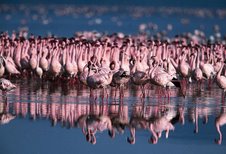
The lake baringo is in the northern part of the Great Rift Valley with a surface area of 168 square kilometers and elevation of about 3,180feets above the sea level. The lake is fed by several rivers, Molo, Endao, Perrkera and Ol arabal, and has no obvious outlet but it has been believed to have underground outlet in the northern part of the lake. The waters are assumed to seep through lake sediments into the faulted volcanic bedrock. It lies off the beaten track in a hot and dusty setting bed rock. It is a critical habitat and refuge for more than 500 species of birds and fauna. A Goliath heronry is located on a rocky island known as Devil Island.


The tugen hills, an uplifted faulted fault block of volcanic and metamorphic rocks, lies west of the lake which runs for approximately twenty kilometers long which enhance the best attraction as a view point to the lake and all surroundings. The laikipia escarpment lies to the east. Water flows into the lake from the Mau hills and Tugen hills. The lake also provides an invaluable habitat for five fresh water fish species namely: Tilapia, cat fish, lung fish, Libelous and black barbas.Tilapia is endemic to the lake.

The Africa lung fish which was introduced to the lake and which now provides the majority of fish output from the lake. The lake is commonly turbid with sediments, partly due to intense soil erosion in the catchments especially on the south of lake. Lake fishing is important to the local social and economic development. The most fishermen round the lake are the IIchamus community who normally lives in the islands and at the southern shore of the lake.


The lake has several small islands:Ol kokwa, Devil island, Rongena island,Parmolok island,lokoros island,kopuso island and Longicharo island. The longest island being Ol Kokwa Island is an extinct volcanic which is located at the centre of the lake? The island measuring five kilometers in length and one kilometer across which is a bout five hundred hectares of land. A group of hot springs discharge a long the shoreline  north –eastern corner of the island and has several fumarole,some of which have precipitated sulphur deposits.Ilchamus community inhabit this island where five hundred and seventy people lives here. Both women and men they practice fishing as their main economic activity. They used a simple raft made of balsa wood as a mode of transport. At this island, a school, dispensary, and fish market is available here.

The Parmolok Island is the second largest island of about ninety hectares of land. The island is being owned by Ilchamus Moran who intended to marry five wives and blessed to have twenty seven children. It is quite unique island due to vegetations of medicinal plants .The rocks arrangement of this island facilitate good view .He keeps Goats, Sheep ,Cattle and poultry Apart from this he does fishing to earn a better living for the family


TERMITE HILL

Termite worker build and maintain nests which house the colony. these are elaborate structure made using a combination of soil, mud chewed wood or cellulose, saliva and faces nest has many functions such as providing a protected living space and water conservation. There are many nursery chambers deep within the nest where eggs and first larvae are tended. Nests are punctuated by a maze of tunnel-like gallery that provides air conditioning and control carbon dioxide and oxygen.

The termite hill has a long hollow chimney usually grows longer. Strong rainfall and human beings destroy this chimney. In most cases chimney is built slightly narrow as it grows up to facilitate security for the entire insects beneath the earth crust. Additional most chimneys bend   towards north way and south way to escape direct sunlight.


THE QUEEN

A primary queen has a great capacity to lay eggs in some species, The mature queen has a greatly distended abdomen and may produce 20,000 to 30,000 eggs a day .The abdomen increases the length to several times more than before mating and reduces her ability to move freely .And attendant workers provide assistance. When the queen mates once with the male and stores the gametes for life, as the male termites dies shortly after mating.

The winged caste as the reproductive caste and they are only termites with well-developed eyes .In a distinct dry season, the winged caste leave the nest in a large swarms after the first soaking rain of the rainy season. After landing at an acceptance site, where they mates and attempt to form a nest in damp earth.

WORKERS

Workers termites undertake the labor of food storage, brood and nest maintains and some defense duty. Workers help in the colony for the digestion food.

The soldiers has behavioral specialization providing strength which are primarily useful against termites attacks .Many soldiers have jaws so enlarge, they cannot feed themselves but instead, like juvenile are fed by workers. Simple holes in the forehead exuding defensive secretions are a feature of the family. Soldiers are usually blind.


DIET

Termites are generally group according to their nest and feeding habitats All termites eats celluloses in its various forms as plant fibre. Cellulose is a rich energy source but remains difficult to digest.
PKP. Kenya safaris
Natural Track Safaris.
 

Tuesday, June 11, 2013

Hunting Safaris in Tanzania


Tanzania has the finest wildlife habitat in Africa and abounds in a wide variety of animal and bird life. Many areas remain untouched by humanity and it is still quite possible to enjoy a traditional tented safari as the famous hunters of old times did many years ago.

In addition to the world famous Mt. Kilimanjaro, the country is noted for its spectacular game reserves, scenery and a wide variety of game animals found nowhere else in Africa. Particularly in the Selous,  one can not only experience the excitement of the Buffalo hunt, but also the adventure of a walking safari in one of the last great wilderness areas in the world.     

Game and bird hunting is legal in Tanzania, and during the hunting season, which runs from July to December of each year, hunters from around the world arrive to embark on private guided expeditions into the African bush.

The Selous Game Reserve is one of the best places for a hunting safari. It is located in the southern part of the country and is the largest hunting conservancy in Tanzania. The vegetation is mainly miombo and mopane bush with dense thickets and open plains ideal for lifetime game-hunting experience.

During a hunting safari, the client and his guide have the entire area of the designated hunting block to themselves, affording the visitor an ideal opportunity to experience the wilds of the African bush without the distractions of other guests.

The Selous is uninhabited by people and is divided into 46 hunting blocks. The area is noted for its large population of dangerous game, especially buffalo. Leopard and lion are plentiful, as well as crocodile and hippo.

Hunting safaris last anywhere between a week to a few months, with guests and their guide setting up camp in a specific hunting block and exploring the entire area over a set period of time. Camps are well equipped with comforts like hot showers, flushing toilets, and walk-in furnished tents.

The most exciting thing is that hunting safaris take visitors to some of the most remote parts of the country on a private basis, and guests often return with a variety of antelope and buffalo species, and sometimes the occasional lion or leopard.

Game viewing and tracking takes up a large amount of the day, with the hunters often rising at dawn, returning to camp for breakfast or lunch, then setting off again in the afternoon until sundown.

Although game hunting is on the top of most hunters’ lists, bird hunting is becoming increasingly popular around seasonal rivers and dams. Guinea fowl, sand grouse, francolin, and some geese and duck species are plentiful throughout the country.

Hunting companies are required to ensure that their commercial activities do not deplete the natural wealth of the country’s wildlife population, and many groups sponsor community wildlife projects that educate local villagers about the environment and help to improve educational and medical services.

Hunting company initiatives have also included anti-poaching education and patrols, clinic and school building, and community education efforts about wildlife preservation and coexistence.

 PKP. Kenya safaris
Natural Track Safaris.

Monday, May 27, 2013

The Tsavo Cheetah Project (TCP).

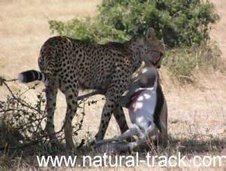
Tsavo Cheetah Project (TCP) which was commenced in April 2011, by the Principle Investigator, Cherie Schroff. The long-term project works in affiliation with Felidae Conservation Fund and Kenya Wildlife Service (KWS) under a research permit which covers the 40,000 km? Tsavo Ecosystem, from the National Council of Science and Technology. TCP is independently registered in Kenya as a national NGO. Prior to implementation, the last scientific cheetah population assessment for the Tsavo region was in 1990, when Paule Gros estimated cheetah numbers in and surrounding Kenya?s protected areas. At a total estimate of 793 cheetahs, 55% was based in Tsavo (Gros 1998). The Tsavo cheetah population along with connecting populations (Mara and Serengeti) makes up one of two globally important cheetah populations in Kenya and one of four in East Africa. The resident Tsavo cheetah population is part of a larger trans-boundary population, where subpopulations in Tsavo, Maasailand, and the Maasai Mara, connect through contiguous areas of Tanzania. In addition to the significance of Tsavo to these connecting populations, the Tsavo ecosystem is recognized as hosting a large and significant cheetah population, in the country’s national strategic plan for the species. This project supports multiple objectives, goals, targets and activities, as outlined in the National Conservation and Management Strategy for Cheetah and Wild dog (2010).

What they are doing:
The aim of TCP is to protect and conserve the Tsavo ecosystem cheetah population with a multifaceted, holistic approach. As a long-term project in Kenya, The Tsavo Cheetah Project monitors cheetahs for trend and threat information on an ongoing basis. TCP employees standardized cheetah monitoring techniques, including direct sightings, our tourists and park staff assisted photographic survey, camera traps, and spoor tracking. Within Tsavo East National Park, the project is also working with KWS to combat off-road driving and cheetah harassment, which has the potential to threaten the cheetah’s chances of survival through behavior alteration.
Since its inception in mid-2011, the project has conducted interviews with residents living on the periphery of the park to compile data on cheetah sightings and conflict issues. We conduct verifications on livestock predation and investigate reports on the retaliatory killing of cheetahs. Education is a key component to cheetah conservation in the Tsavo region. Therefore engaging communities on the proper identification and differentiation between spotted cat species and specific predator behavior, coupled with on-site assistance on livestock husbandry improvement, are critical ongoing activities of TCP. All field activities in Tsavo East will continue throughout the park and adjacent land, eventually expanding with added staff throughout the ecosystem to assess cheetah population threats and demographic trends overtime.

What they Need & What You Get
The requested total amount of $5,000 is estimated to cover a three month period (July ? September) in the field, including vehicle rental pending award for vehicle purchase
? Vehicle hire / petrol / maintenance fees (only a few activities can actually be done on foot; this is lion and elephant habitat, too, and a vast area)
? Camp and sustenance (yes, we require food and shelter, on the lowest possible budget)
? Local assistant salary for cheetah education program implementation (essential for cultural issues, language barriers and capacity building)
? ?A Tsavo Cheetah?s Ecosystem? educational materials for local schools and community visits where conflict exists (it?s important to make it fun, interesting and engaging for local children and adult residents).
If any donor wants these costs broken down to monthly / weekly / daily amounts and the estimation for booklets and poster materials, please contact me. Receipts in Kenyan shillings can also be provided to donors

What you get:
$25: Acknowledgement on the project website and social media pages.
$100: Acknowledgement on the project website and social media, and a private photograph of a newly identified Tsavo cheetah, during 2013.
$1000: Acknowledgement on the project website and social media, and two private photographs of newly identified Tsavo cheetahs, during 2013.
$2,000: Three day period with the project in the field (covers a daily / packed or locally bought lunch and transportation for two in the project vehicle during daily field activities for a 3 day period-dawn to dusk!).
$5,000: Seven day period with the project in the field (covers a daily / packed or locally bought lunch and transportation for two in the project vehicle during daily field activities for a 7 day period-dawn to dusk!).
If anyone?s interest in exceeding this seven day time period for an additional donation, this is also possible!
The Impact
The best way that you can help save the cheetah, is to donate to specific on-ground conservation projects, like ours, who have secured the permits and partnerships to do the field work but only require additional funding.

Grant awards do not last forever and rarely do they cover all field costs, such as petrol and research assistant salary. There are often time periods in between applications and awards when researchers and conservationists in the field rely solely on in-kind donations and fundraising. Critical project activities can only continue on a consecutive basis, if funding is continuously flowing in?
Our community assistance and educational programs to reduce cheetah conflict and persecution , cheetah ID and monitoring inside and outside the Tsavos, should not be halted due to lack of petrol, camp, or vehicle rental costs… Threats to these cheetahs do not decrease as project funds do, unfortunately.
Please consider assisting in our research and conservation efforts
to save this critical Trans boundary population in East Africa.

PKP. Kenya safaris
Natural Track Safaris

Tuesday, March 19, 2013

Facts about the’ King of the Jungle’

Family: Felidae ?? Species: Panthera leo

Famously referred to the King of the jungle, they actually do not inhabit jungles
It is partially true to refer to the lions as ‘King of the beasts’.? It is a fact that they really are kings of the predatory beasts, but they can be easily backed down or killed by elephants and water buffalo.? A pack of hyenas can also back down or even kill a solitary lion.

But they are in themselves packed for the kill. They have strong, compact bodies and powerful forelegs, teeth, and jaws for pulling down and killing prey. Their coats are yellow-gold, and adult males have long, dark, shaggy manes. Young lions have light spotting on their coats. Their strength is also reflected during mating whereby can copulate up to as many as 100 times in a 24 hour period
Male lions grow larger than females, reaching up to ten feet long (females reach up to nine feet long), plus a two- to three-foot-long tail. Male lions weigh from 330 to 530 pounds; females weigh 270 to 300 pounds. Lions stand between 3-4 feet tall at the shoulder.

They are the only true social members of the cat family and live in groups called prides.
All females in a pride are related
All lactating females will allow any cub in their pride to nurse
Lions run at a rate of 50 mph, and sleep up to 20 hours a day
Tigers are lions’ closest relatives. Without their coats, lion and tiger bodies are so similar that only experts can tell them apart.

Their roar can be heard up to five miles away.
Male lions can usually only hold on to a pride for 2-4 years before a younger, stronger male or coalition of males throws him out and takes over.

Many people only think of the females as doing the hunting, but as males spend much of their lives in search of a pride, they too must fend for themselves and are quite capable of hunting.
Though grown-up lions have rarely been known to have spots, there is one male in Masai mara that I have seen time and again that was born with a huge black patch on the chest and inner front left leg. I have watched him from birth till he was kicked out of the pride with his brothers. Definitely he left the vicinity and only hears about his where a bouts from time to time.
Lions are the only sexually dimorphic members of the cat family.
Male lions are the only members of the cat family to have a mane.
They are the only felines with tufts at the ends of their tails.

Female lions (lioness) reach two thirds of their adult size by the time they are 2 years old.
Males begin to really grow between 3 and 3 1/2 years and by 4 will be almost their adult size and weight
Both males and females continue to grow until they are 6 years old, primarily becoming more massive

Habitat
Lions inhabit a wide range of habitats, from open plains to thick brush and dry thorn forest.
Diet
Lions eat primarily large animals, such as zebra and wildebeest, weighing from 100 to 1,000 pounds. In times of shortage, they also catch and eat a variety of smaller animals from rodents to reptiles. Lions steal kills from hyenas, leopards, and other predators, but may also lose their catches to hyena groups. Lions may also feed on domestic livestock, especially in areas near villages.
Reproduction
Female lions usually give birth to a litter every two years. Females are receptive to mates for a few days several times a year, unless they are pregnant or nursing. Mating spurs ovulation. Females give birth to one to five cubs after a gestation of about three and a half months. Cubs nurse for six months, but start eating meat at three months. Due to varied dangers, including starvation during times of food shortage and attacks by male lions taking over prides, up to 80 percent of lion cubs die within their first two years of life.
Life Span
Zoo lions may live up to 25 years, while wild lions live about 15 years.
Behavior
Lions live in groups called prides, which may include from several to 40 individuals. Pride mates associate in sub-groups within the pride. Female pride mates are related to each other. Although both males and females defend the pride’s territory, the larger males take on most defense duties, marking territory with roars and scent marks (urine). Females do most of the hunting.

Several females stalk prey from different angles to within 100 feet before attacking the targeted animal. Females stay in their mothers’ prides for life, unless food scarcity forces them out. Young males are driven from their prides when they grow large enough to compete with the dominant males.
Young males join in coalitions, usually with brothers and cousins, and search for a pride to take over. Males entering a new pride will kill all cubs that cannot run from them. In India, female and male lions live apart, joining only to mate.

PKP.?Safaris in Kenya desk
Natural Track Safaris

Saturday, February 9, 2013

Facts you should know about the Giraffe


Facts you should know about the Giraffe
Giraffe is one of the most amazing animals especially because of the long neck that makes it sometimes cumbersome and prone to a couple of problems. We will see them as we proceed and you will be able to understand more.

African ruminant mammal, Giraffa camelopardalis, live in open savannahs south of the Sahara and has only one family member, the Okapi. The giraffe is the tallest living mammal.  Head/shoulder length is approximately 13' for the male.  Shoulder height is 8-12', overall height 15-19'.  Weight is 1,100-2,800 lbs.  The reticulated giraffes are handsomely patterned in golden browns, with a coarsely netted (reticulated) pattern mainly quadrangular in shape.  Males and females have stiff manes along their necks.  Both sexes have horn-like structures called ossicones on top of their heads between their ears. These ossicones are present at birth in the form of small knobs of cartilage covered with skin and hair which becomes bony nodules with age.  

They have seven vertebrae in neck, the same as man and most other mammals despite the long neck. Only that the vertebrae are much bigger. The tail measures up to one yard with a terminal tuft of stiff, black hair. 
They have long tongues that measure 18-21 inches long. The inner part of the tongue is pink in color, and then changes to a purplish-black color for the last 6 inches that are commonly visible.

A quick look at the adaptations of the Giraffe
They have long legs and neck, long, tough, prehensile tongue, and leathery mouth for food gathering. Their coloration is protective. They are tall with good eyesight for watchfulness. Giraffes have high blood pressure (240/160) for pumping blood to the brain. Herds are small and loosely constructed of 5-15 individuals, consisting of one bull with females and young.  Other bulls are solitary or in pairs. 

They usually sleep standing up. Going for a month without water is also possible as an adaptation to long drought periods in their native areas.   A browsing ruminant that eats regularly throughout the day, the giraffe prefers young leaves and shoots at tops of acacia trees which sometimes ends up shaping the regularly visited trees.  They prefer to drink regularly, but can go without water for several days.  Giraffes can run up to 35 mph.  Predators are leopards (prey on young), lions, and man.  Giraffes kick with their hooves and slam with their heads. A giraffe usually sleeps for only 1-12 minutes.

Off springs
Giraffes are non-seasonal breeders, usually producing one calf after a gestation period of 14-15 months.  Newborn giraffe calves begin their lives by falling up to about 6 feet to the ground, and weight  87-107 lbs.  They become sexually mature between 3 and 4 years of age and have a life span of about 25 years and up to 30 in captivity. Full body size is not reached until five years of age.

It is interesting to note that...
The carotid artery that carries blood from the heart to the head is thick, muscular and elastic, ballooning when the giraffe stoops to absorb increase in pressure.  When the giraffe raises its head, a series of check valves in the inch-wide jugular vein prevents a sudden back flow from the head, emptying the brain.  They are most vulnerable to predators when drinking or lying down.  They may see red-orange, yellow-green, purple, green and blue as colors.  Their scientific name means "camel-leopard-like one who walks swiftly."  Their spot patterns are as individual as fingerprints. They are among the very few mammals that cannot swim at all.  Giraffe’s have a variety of sounds but they  are rarely heard. They may grunt of snort when alarmed, females may whistle to call their young, and calves can bleat.
 

PKP. Safaris in Kenya desk
Natural Track Safaris


Monday, January 21, 2013

ARTICLE TERMITES


The termites are a group of eusocial insects usually classified at the taxonomic rank of order Isoptera. sometimes called "white ants", though they are not closely related to true ants. Termites live in colonies that, at maturity, number from several hundred to several million individuals. Colonies use a  self-organized systems of activity guided by swarm intelligence to exploit food sources and environments that could not be available to any single insect acting alone. A typical colony contains nymphs (semi-mature young), workers, soldiers, and reproductive individuals of both genders, sometimes containing several egg-laying  

queens.termites divide labour among gender lines, produce overlapping generations and take care of young collectively. Worker termites undertake the labors of foraging, food storage, brood and nest maintenance, and some defense duties in certain species. Workers are the main caste in the colony for the digestion of cellulose in food and are the most likely to be found in infested wood. The soldier caste has anatomical and behavioral specializations, providing strength and Armour which are primarily useful against ant attack.termites undergo incomplete

metamorphosis, with their freshly hatched young taking the form of tiny termites that grow without significant morphological changes. Termites are generally grouped according to their feeding behavior. Thus, the commonly used general groupings are subterranean, soil-feeding, dry wood, damp wood, and grass-eating. Termite workers build and maintain nests to house their colony. These are elaborate structures made using a combination of soil, mud, chewed

wood/cellulose, saliva, and farces. A nest has many functions such as to provide a protected living space and to collect water through condensation. Nests are commonly built underground, in large pieces of timber, inside fallen trees or atop living trees. Some species build nests above-ground, and they can develop into mounds. In tropical savannas the mounds also known as "anthills" may be very large, with an extreme of 9 meters (30 ft) high . In many cultures, termites are used for food . Ecologically, termites are important in nutrient recycling, habitat creation, soil formation and quality and, particularly the winged reproductive, as food for countless predators. In addition, scorpions, lizards, snakes, small mammals, and birds live in abandoned or weathered mounds, and aardvarks dig substantial caves and burrows in them, which then become homes for larger animals such as hyenas and mongooses.

PKP. Safaris in Kenya desk
Natural Track Safaris