Saturday, October 9, 2010

The Warthog

Scientific Name: Phacochoerus aethiopicus

Size: 30 inches at the shoulder

Weight: 120 to 250 pounds

Swahili Name: Ngiri

They are found in most of Africa south of the Sahara and are widely distributed in East Africa. They are the only pigs able to live in areas without water for several months of the year. By tolerating a higher-than-normal body temperature, the warthog is perhaps able to conserve moisture inside its body that might otherwise be used for cooling.

Males weigh 20 to 50 pounds more than females, but both are distinguished by disproportionately large heads and the warts-thick protective-pads that appear on both sides of the head. The face is fairly flat and the snout elongated. Eyes set high on the head enables the warthog to keep a lookout for predators even when it lowers its head to feed on short grass.

The warthog's large tusks are unusual: The two upper ones emerge from the sides of the snout to form a semicircle; the lower tusks at the base of the uppers are worn to a sharp cutting edge. Two large pairs of warts occur below the eyes, and between the eyes and the tusks, and a very small pair is found near the jaw (usually just in males).

Sparse bristles cover the warthog's body, although longer bristles form a mane from the top of the head down the spine to the middle of the back. The warthog characteristically carries its tail upright when it runs, the tuft waving like a tiny flag. As the young run in single file, the tail position may serve as a signal to keep them all together.

Warthogs trot with a springy gait but they are known to run surprisingly fast. Warthogs live in family groups of a female and her young. Sometimes another female will join the group. Males normally live by themselves, only joining the groups to mate. Warthogs engage in ritual fights in which they charge straight on, clashing heads when they meet.

Fights between males can be violent and bloody. When water is available, warthogs drink regularly and enjoy wallowing in muddy places. As part of their grooming they also take sand baths, rub against trees and termite mounds and let tick birds pick insects off their bodies. Warthogs sleep and rest in holes, which at times they line with grass, perhaps to make them warmer.

Although they can excavate, warthogs normally do not dig holes but use those dug by other animals, preferably aardvarks. When water is available, warthogs drink regularly and enjoy wallowing in muddy places. As part of their grooming they also take sand baths, rub against trees and termite mounds and let tick birds pick insects off their bodies.

Before giving birth to a new litter, the female chases away the litter she has been raising and secludes herself. Female warthogs only have four teats, so litter sizes usually are confined to four young. Each piglet has its "own" teat and suckles exclusively from it. Even if one piglet dies, the others do not suckle from the available teat. Lions and leopards are the warthog's chief enemies.

Warthogs protect themselves from predators by fleeing or sliding backwards into a hole, thus being in a position to use their formidable tusks in an attack. When alarmed, the warthog grunts or snorts, lowers its mane, flattens its ears and bolts for underground cover. The warthog has poor vision (though better than most other African wild pigs), but its senses of smell and hearing are good.

PKP-kenia safari desk

Natural Track Safaris

The savannahs of Kenya

The savannahs of Kenya are home a wide range of wildlife. One of the most frequently seen wildlife is the spotted hyena, yet little is known about them.

In the traditional African society, the Hyena has been branded 'the coward one'.

This has been due to the way of feeding of the hyena. Known as a scavenger, the hyena is actually a great hunter and scavenging only makes 5%- 10% of their meals.

They rarely leave any evidence especially because they devour everything. For example they can make a kill in the night and the only sign will be light blood stains.

In the recent years the complexity of the hyenas has been revealed. Lots of time has been dedicated to studying them. This article is about hyenas and their survival tactics in the savannahs of Kenya. They range throughout sub-Saharan Africa in savannah, arid areas, and open woodlands. So far they aren't present at the coast.

There exist three species of hyenas in Africa. Two species are found in Kenya.

The most common being the spotted hyena, crocuta crocuta.
They live in groups called clans and the clan is under the leadership of the oldest female, the alpha female. Interestingly, the females are dominant over the males and are heavier than them. The females genitalia are very masculinized which contributes to their being aggressive. Such sex dimorphism is not common with other wildlife. This is due to the presence of higher level of testosterone in the female's body than that of the males.

A distinguishing feature with the hyenas is the 'haunch-back' and short hind legs. They hold their head low when they walk. Usually the head has a rounded skull and long ears. They have extremely strong jaws and a complex acidic digestion system. This is one of the factors that give them a step ahead for survival. They are capable of ingesting bones, horns, hooves and the tough animal skins.

Only the hair is not digested and this usually comes out in the form of bolus or locally referred to 'hyena hair ball'. All this bone matter that they eat is what makes the hyena feces chalk-white.

They hunt in packs in a way that could be termed as ruthless as they do not have a killing bite. They lack in hunting technique and most cases they run down their victim to exhaustion. Usually they attack their prey and tear chunks before their victim dies.

It is interesting to know that lions steal lots of their kills. It is true that hyenas do the final cleaning by chewing the bones and the skins left by others. In some cases the hyenas have succeeded to steal from the lions but in most of occurrences the reverse is more common.

The reproduction and life cycle is not seasonal. The females do not however mate with their members of the clan. They can take any other wandering male for mating and discard him. Four months is the gestation period and usually give birth to up to four cubs. These are usually black in color with some others having small taint of black. A weird thing that happens with the cubs is competition over who nurses first.

This in most cases result in fighting for dominance. The looser usually starves to death and this is only with the female cubs. Hyenas, unlike other wildlife take very long to wean their cubs. It may take between 14-18 months. The female can lactate up to 12 months with milk that is very high in protein percentage.( 14%). The cubs start following the mother to the point of kill when they reach 1 year.

They do not bring back food to the den. They eat to their fill on the spot.
The female cubs stay in the clan of their birth but males are kicked out when they reach around 2 years. Apart from playing with the cubs the male has no role in upbringing of the cubs.

One clan can have between 20-100 members, all on the matriarchal system. All the members are related. Each clan digs its own den which comprises of deep and long tunnels to accommodate the clan. They mark their territory through anal sac secretions. This is a paste that they use to define their boundary and is deposited at the edge of their territory. That is their home-territory that they protect and intruders are not welcome. They have a greeting system of sniffing each others genitalia and also as a way of identification or recognition within members of the same clan.

To the untrained eye, it is difficult to differentiate between males and females. This is because of the physical resemblance of the female's genitalia to that of the male. But in any case they are female organs. The females are not hermaphrodite as some have claimed at first sight.

Hyenas have 'toilets' whereby all the members go to deposit their dung. This adds to the boundary markings of their territory.

They communicate in a number of ways: When about to attack the tail is held high, when it is held forward over the back, it is a sign of excitement. And when frightened they hold the tail tucked between the legs. When there is presence of food, this is the time you hear the famous 'hyena laughter' especially in the night. This laughter is a call to other clan members and can be heard up to 3 kilometers away.

It is important to note that though hyenas portray cowardly behavior, they can be extremely dangerous. They should be left alone, least intimidated and their respect awarded to them.

PKP-Kenya Safari desk

Natural Track Safaris

Bottom of Form

THE MAGICAL PILGRIM

Africa is changing at a rapid pace and human encroachment into wildlife reserves has continued to erase the traditional routes and wildlife migratory corridors. Coupled with development and massive changes of the way of life, the image of wildlife roaming free in the jungles of Africa is slowly getting expunged. Fortunately, Kenya in tropical Africa still holds on to its charisma of an open limitless land. It is one of the places in Africa that still prides in wildlife diversity and concentration.

One of these amazing places is Maasai Mara national reserve. With its ideal location; - south west of Kenya, 290 kilometers from Nairobi, Mara’s profusion of wildlife and remoteness implants memories in-buyable with money.

The wildebeest migration is a recent phenomenon with 60’s and 70’s marking the biggest boom with about 250,000 individuals. The number has since then risen gradually to the current population of over three million individuals. Add to it an estimated 1.5 million zebras, thousands of gazelles and hundreds of impalas and the result is one of the most magnificent scenes in the world. This massive display of ungulates attracts hundreds of big cats as the population provides abundant prey while the giant crocodiles lie in wait, patiently, as the herds come to cross the river or to drink.

Many have described it as the world’s biggest spectacle, while others have come back time and again, to witness this panoramic faction of wild animals’ itinerant freely through unspoiled savage wilderness. While the drama culminates, the air fills with clicks of cameras flicking tirelessly to capture this unique world re-known spectacle.

However, as the phenomena may seem to astound and amuse scores of visitors and conservationists, tally the Maasai community out of the glee. To them, the phenomenon is a big calamity as the wildebeests transmit diseases to their herds and poison the waters with their fetal sacs and also compete with their vast boran cattle herds for pasture and water.

This world famous migration is a circle of life which in simple terms means ‘there isn’t a start or an end’ but just where the herds are sited at a particular time subject to availability of pasture. The plains of Ngorongoro conservation Area in Serengeti are a favored spot as grass abounds and the wildebeest find a safe place to grace. It is also here that over five hundred thousand new calves are born and many are taken by the nearby waiting jackals or hyenas. Casually speaking, the gnus (wildebeest) go to Mara for ‘honeymoon’ and then proceed to Serengeti for breeding. The new born’ have little time to strengthen their legs since soon after they are born, the pilgrim" continues.

By April, the rains are over in Serengeti and the plains have dried up, thus these natural lawn mowers have to instinctually abandon the exhausted grasslands of southern Serengeti. They therefore gather and commence the extensive stride northwards and westwards to the already tall grass of the western corridor near the shores of Lake Victoria.

The pioneers of this pilgrimage are the majestic herds of zebras. They prefer the long shoot of the coarse grass thus leaving behind shorter grass favored by the wildebeests. In late June to July the mass start pouring into the Kenya’s Masai Mara reserve where fresh tender and mineral rich grass is already waiting. Here they meet the resident Mara populations which add up to a hundred and fifty thousand individuals. Also commonly referred to as the Loita plains herds, they spend most of the season northeast of Mara. When it gets dry, they pour into the interior of the Mara in search of greener pastures.

The migrating herds spend roughly three to three and half months in the Mara crossing through Sand River (a tributary of the Mara River) along the boundary of Kenya and Tanzania. They trek westwards and cross the Mara River and sometimes the Talek River. Usually, around this time, heavy rains on the Mau escarpments (Origin of the Mara River) fill the Mara River to the brim.

This is a good time to watch the trunk-looking Crocodiles, while they spectacularly anticipate and grasp the ‘imminent feast’. Finally, the gnus venture into the river! This gregarious coordinated behavior of the herds, usually teamed with zebras, creates an unimaginable scene – Just what the cameras have been waiting for!

They wander along the river looking for a convenient crossing point. This is a moment filled with tension for both the gnus and the audience. They survey for a less steep spot oblivious of the perceptible jeopardy. Finally, one takes courage and plunges into the river and magically the rest falls onto the footsteps and in one organized line cross the river.

In addition to the crocodiles’ merciless attacks, accidents also occur. The river's current can be too strong for some especially the young ones or simply, getting stuck between the rocks in the river and breaking limbs – a direct ticket to the jaws of the giant crocodiles. Finally, the crossing is done and the trek to their unknown (or known) destiny continues

In the month of October, they are already heading to Serengeti where the rains have treated the southern grasslands to lush, green carpet of rich grass. Once again, they are heading to the southern plains, where a new generation will be born to start the cycle of life all over again.

PKP-Kenia safari desk

Natural Track Safaris

A TALE OF AFRICAN RHINOS


Kenya wildlife safaris: African rhinos

In Africa today, the fight for growth of the rhino population is an everyday activity. After being declared an endangered species, Kenya has put up big efforts financially to see to it that their habitats have been safe guarded.
The rhino belongs to the family Rhinoceroteridae. They are 5 species placed in 4 genera. Three of these species are found in south-central Asia and the other two live in Africa – south of the Sahara.
They inhabit savannahs, shrubby regions and dense forests. The African species live in more open areas than do the Asian species. Their habitat has to generally have access to water as they usually drink everyday.
Their horns are dermal growths originally composed of compressed keratin. Usually they have 1-2 horns. Their horns, their beauty have been their dilemma for ages. Powdered Rhino horn has been used extensively in traditional medicine in Asia and to make ornamental dagger handles in the Yemen. The demand is so great that traders are prepared to pay poachers vast sums to kill rhinos for their horns causing a wholesale slaughter in Kenya.
To stop these abuse, governments and conservation bodies such as Save the Rhino teamed up to halt the cruelty. Thanks to them, the overall decline of the rhino has been halted, and populations in Africa are beginning to stabilize.
Rhinos are known to have poor eyesight but strong hearing and smell. Both hind and forefeet have 3 digits with a small hoof while the tough and wrinkled skin has very few scattered hairs and the tail ends with stiff bristles.
The history of the rhino can be traced back to 45 million years ago. The Baluchitherium, an ancestor of the Indian rhino, was the largest land mammal that ever lived. It was 18 feet high and 36 feet long. It lived over 20 million years ago.

Female rhinos give birth every 2 years to a single calf, which is active soon after birth.
The calf remains with the mother until the next offspring is born. Sexual maturity is reached at 7-10 years for bulls and 4-6 years for cows. They have a life span of up to 50 years and a gestation period of 420-570 days.

It is important to note that the African rhinos are more aggressive than Asian species.
They use their horns to attack and toss their enemies and this can be predominantly dangerous and can kill attackers instantly.
African white rhinos have a preference of feeding low to the open grounds whereas the black rhino usually browse on leaves and have a tendency to stay hidden. They have been noted to be more active in the evening, through the night and in early morning, spending their days resting in heavy cover.

Rhinos sleep in both standing and laying positions and love to wallow in muddy pools and sandy riverbeds. They penetrate dense thickets by shear force, often leaving behind trails that other animals later use.
They run with a cumbersome motion, reaching top speed at a canter but can however, attain speeds of up to 45 km per hour for short distances. Unlike the white rhino-calf, the black rhino calf normally runs behind its mother.
Basically the black rhino is more solitary and territorial except for the mother-child unit. Groups of adult cows or bachelor bulls are sometimes formed, however, and during the mating season pairs of rhinos may stay together for up to 4 months.
Rhinos mark their territories with urine and by dropping their dung in well-defined piles that can reach up to 1 m in height. They often furrow the areas around these piles with their horns and make the piles even more conspicuous.
The black rhino has a wide vocal range and can possibly communicate like an elephant, through frequencies below the range of human hearing. Breathing is an important part of communication.

The current available statistics show an estimated 20,000 black rhino in Kenya in the 1970s. By 1982 the population was reduced to fewer than 400. Since then, their number has increased and now stands at over 450. The number in fenced areas has risen at an average rate of four percent each year when the conditions are good.
Since 1984 the Kenyan government has pursued an active program devoted to the
recovery of Kenya’s black rhino, with efforts centering on the development of specially protected or fenced sanctuaries on government and private land, such as Lewa.

Rhino populations under custodianship both on private land (Solio Ranch) and in some State-run areas (such as Nairobi and L. Nakuru National Park) have provided set up for new populations (including reintroducing animals into an electrified-fence sanctuary inside the KWS-run Tsavo West and Meru National Parks). The private sector thus plays an important part in the conservation of rhino in Kenya and currently supplies many of the animals being used to restock state parks.

Kenya is currently the stronghold of the Eastern African subspecies Diceros bicornis michaeli, a home to about 88 % of the population in 1995. Like South Africa and Namibia, Kenya is doing translocation to set up new populations while aiming to ensure that donor populations remain productive.
The public plight of the black rhino has attracted support from many different areas. Today, scientists are formulating a method of «fingerprinting» rhino horn based on the nutrient content of each specific rhino conservation area. This will enable them to pinpoint the area a rhino came from, its family group, and even its preferred diet. It is also an important step toward eradicating poaching, as scientists will be able to determine where a rhino was when it was killed.

Natural Track Safaris

Monday, May 31, 2010

The rugged parks of Northern Kenya

If you have enjoyed a safari in Kenya, that’s fine, but there
is still more apart from the regular Big-Five safari craze.
Mainly the remote and sometimes hard-to-reach attractions
of the North Rift. The northern circuits are for the adventurous
and for those seeking to explore Kenya at its most rugged.

Parks, lakes and attractions that include Lake Bogoria,
Lake Baringo, Kamnarok, Turkana’s South and Central Islands,
Nasolot, Sibiloi and Marsabit see only occasional visitors.
But these parks hold a particular fascination for those seeking
that wild adventure and to go off the beaten track. But you need
some time on hand hear, no rushing.

There are a few that need some extra mention and what it is
famous for.
Lake Bogoria National Reserve is famed for its natural host
springs and geysers. It is good for bird watching and has its fair
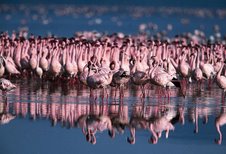
share of game. Currently it is one of the best place to watch flamingoes
as the there is a big concentration though some have already
started to move back to lake Nakuru.

Close by, Kamnarok National Reserve is perfect for bird
watching and game viewing.
South Turkana National Reserve and Nasolot are on either
side of the main highway. Nasalot overlooks one of Kenya’s
unique features, the immensely deep crevice of Turkwell Gorge.
The Lake Turkana National Parks – Sibiloi, Central Island –
form a UNESCO World Heritage Site. Lake Turkana is the most
northerly of the Great Rift Valley lakes.

Camel derby is a big-time event in this region. The annual
Maralal Camel Derby is the only one of its kind in Kenya.
Accommodation is scarce and where it does exist, it is geared
to the independent traveler.
Laikipia, the hot new destination for wilderness lovers, is fast
developing into a major, but exclusive, high density game
viewing area. Laikipia is also strong on bio-diversity and
home to many threatened or endangered species. At the
same time, it is an area where game viewing can be combined
with non wildlife activities such as ballooning, camel riding,
fishing, hiking, horse riding and mountain biking. These are
areas to add to your safari in Kenya itinerary if time allows you.

PKP- Kenia safari

Natural Track Safaris

Saturday, May 29, 2010

Kakamega forest region brought closer..

Kenya holiday safari: Kakamega forest

More and more visitors to Kenya are now using air services to the national parks to enable them spend maximum time in the parks as opposed to spending time cruising long road distances to the parks – a good choice when time in the destination is limited and you wish to see many of the country’s attractions. It is therefore evident that the beginning of this week was marked by one of the regional commercial event kicking off and opening doors to another fly-in destination, Kakamega.

Kenya’s rapidly expanding regional airline, and of course, the undoubted ‘region’s first true low-cost, low-fare airline’ Fly540, has spread its wings to Kakamega with the introduction of daily flights from Nairobi. This is great move in opening up Western Kenya to their growing domestic network, while at the same time opening it up more for tourism and business travel.

The Kenya Tourism Board has, in the recent past, created additional circuits in parts of the country less visited by overseas visitors including Western Kenya among others. Western and Nyanza circuits are suitable preferences for any one seeking off the beaten track African safari experience. The added air-link will no doubt lure tour and safari outfitters in Kenya and across East Africa to be more proactive when promoting these clandestine and offering tours and safaris to the opened up regions.

Western Kenya circuit is home to the well-preserved attractions including the famous only remnant equatorial forest in Kenya – Kakamega forest, the Mt. Elgon National park – famous for numerous salt-filled caves collectively know as Kitum – the caves offer one of the most panoramic elephant salt licking sights in Kenya. This is without mentioning Ndeere Island, the great islands of L. Victoria and the must-visit Impala sanctuary.

Kakamega forest is 15km from town and is home to over 300 bird species, 350 species of trees and 27 species of snakes. In addition, it is the habitat of over 400 species of butterflies, reptiles, molluscs and seven primate species. It is worth adding to your kenya safari itinerary.

Ruma and Saiwa swamp national parks offer the only known protected areas for the endangered yet attractive Roan antelope and Sitatunga respectively. In addition to wildlife, western Kenya is home unique shrines and historical monuments, the Kiti Mikayi and Timlich Ohinga forests, the Kapenguria jail where the first President, Mzee Jomo Kenyatta had a stay.

Still on western Kenya safari circuit is Lake Victoria – the world second largest fresh water lake and source of the great River Nile is less that 20 minutes drive from Kisumu city. It also boasts Kogelo village – the paternal home of the US president Barack Obama.

There will be a Fly540 office in Holden Mall near Nakumatt Kakamega town to cover Western Kenya and an office at the Kakamega airstrip. The Fly540 Beech Craft 1900 aircraft will depart from Jomo Kenyatta International Airport (JKIA) each day at 7.00 a.m. The return flights will depart from Kakamega at 8.15 a.m.

Passengers will pay an introductory return fare of Ksh shillings 9,540 plus taxes. Tickets are available from travel agents and the Fly540 offices.

Fly540 commenced operations in November 2006 with a daily flight between Nairobi and Mombasa for local and overseas business and holiday travellers. The airline’s value for money flights won instant popularity and Fly540 now has nine destinations in Kenya with regional services to Bujumbura, Entebbe, Zanzibar and Kilimanjaro, Manyara and Serengeti.

Adventure

Kenya Safari

Sunday, May 23, 2010

Camping in Kenya


No doubt, camping safari is the most flexible. You don’t have to follow strict pre-arranged schedules, lodges booked months if not weeks in advance, meal times and such services. Camping safaris go uncompromised. Indeed they are all permitting and you are in for real adventures.

How about camping part of the time, and lodge safari part of the time? You can use Camping safaris to spice up your holiday some more. And whats more, heey! that will also save you a few coins..

There is little impact on nature. Mainly because it does not require much permanent structures which can cause irreversible or long lasting impoverishment on mother nature. The extent here varies, but much lower compared to lodges.

Camping safari offers you a real natural uncompromised experience. Sit by the camp fire, and just listen to the African wildlife and many nocturnal creatures. It is just real nature!

It is an experience that gives a real feeling of adventure that not only brings you closest to the wilds, but also gives you the opportunity to learn a few words in some local languages, make mistakes in pronunciation and laugh together with the camp team. Visit amazing traditionally architected African villages and sample the authentic unsurpassed artifacts of African people.

On several occasions and upon requests to the cook, you get to taste great African cuisines. Some you may like and some you might not, but most importantly, the feeling of exploring is great.

In addition, friends, families or work mates who love outdoor evenings of fun, simple games, or those silly things we enjoy as friends or family, these camping are worth a try.

Camping safari is one of the few styles that will leave you appreciative of the value for your money. And apart from camping in the parks/reserves, Kenya coastal areas have nice beaches to camp too. But checking best locations in advance is always recommended to get more details.

Kenya safaridesk